
Crowley: light the first gate.
Light the first gate at Talleyrand. Then watch the network wake up behind it.
Talleyrand exit gate · your yard, todayRight now a carrier is sitting on nine of your chassis. You cannot prove it. You are paying for it.
A chassis rolls out of Talleyrand and Crowley has no record of who took it, whether it is earning on a Crowley load, or when it is coming back. Multiply that by every gate and every shift and the pool stops being an asset you control. It becomes one you hope shows up. The same blind spot runs through every yard you operate.
- no record of who took it
- one you hope shows up
- every yard you operate
We did not model this. We ran it, on your yard.
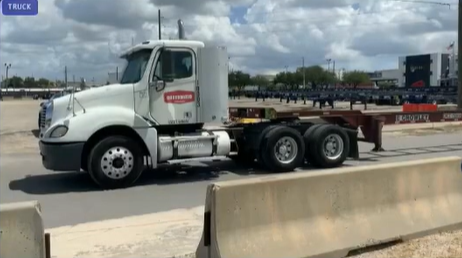
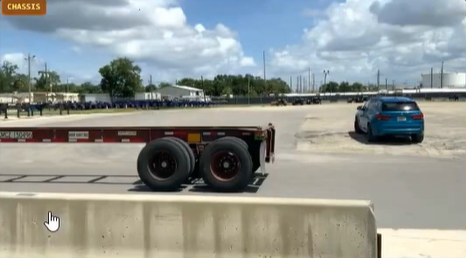
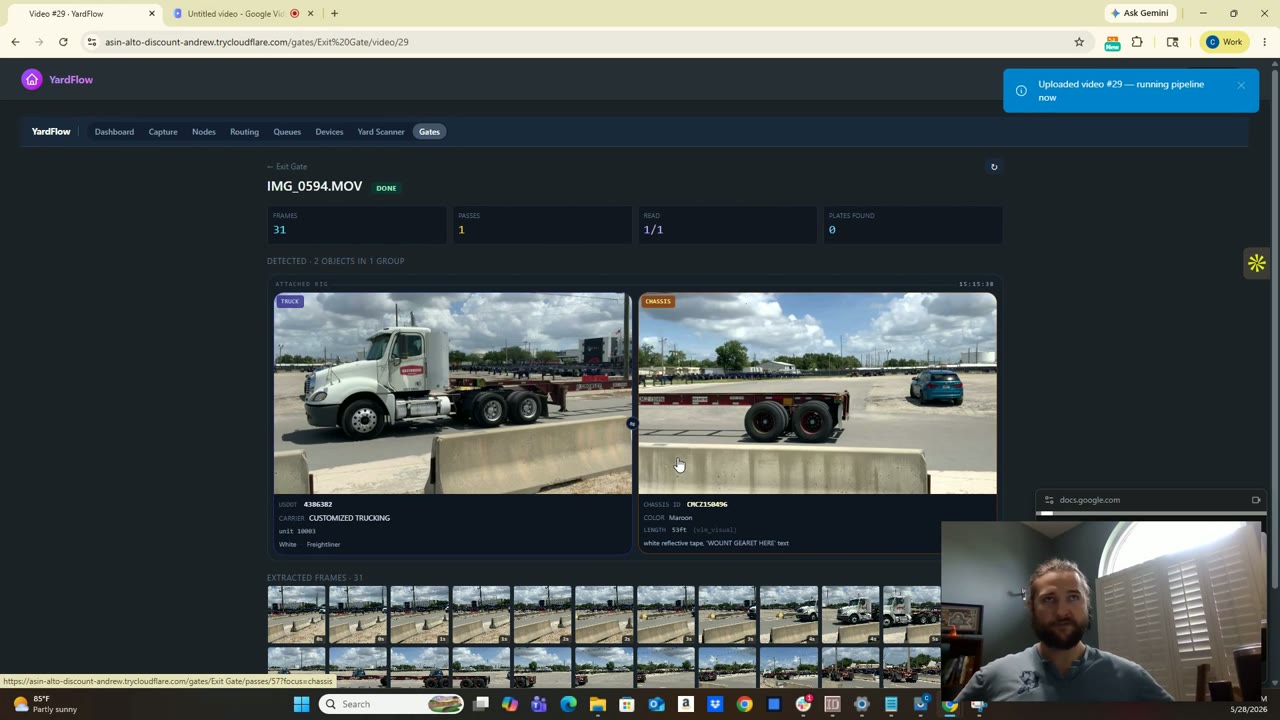
A camera at the gate reads who took which chassis, when, and whether it came back. No app for the driver, no gate arm, no change to how the yard runs. We pulled this straight from your own Talleyrand footage: carrier, DOT, truck, chassis, genset, timestamp. We start with chassis because the leak there is obvious. That same gate read is the front end of an operating layer for the whole yard, and every yard in the network.
A chassis sitting in a carrier yard is dead capital. The friction around it costs more.
A chassis is a $20,000 asset. Parked in a carrier yard, it is not earning. Walk it off and you buy another or run short and scramble, eating repositioning cost, missed port windows, and dray delays. That is the visible cost. The larger one is friction: a yard full of assets in motion that nobody can see or sequence, so every delivery pays a tax. Trucks idling for a spot, equipment nobody can locate, moves that stall. And that tax is steeper than it has been in years, with rates flipped to the carriers and every idle truck billing at the new rate. Take the friction out and the same yard, the same fleet, the same assets move more freight. The fix is not more equipment. It is keeping what you already own visible, accountable, and rolling.
- a $20,000 asset
- every delivery pays a tax
- bills at the new rate
- not more equipment
The leverage to call a carrier by name and say: you have had nine of our chassis for eleven days, bring them back.
A live count of every chassis in the pool, by class: who took it, when, and whether it is back. An aging report that names the carrier sitting on your equipment, by DOT number. Alerts the moment a carrier pulls more than its share or a chassis goes long. A check that flags chassis pulled from Talleyrand but never run on a Crowley load. And the blueprint to do the same with every asset, at every yard.
- names the carrier sitting on your equipment
- with their DOT number
- every asset, at every yard
Talleyrand is not the project. It is the template.
Talleyrand is one pool; chassis are one asset. You run yards up and down the coast and in Puerto Rico, each full of friction of its own. Prove the accountability and the flow gain here, on your own numbers, and you have an operating layer you stamp across the network. Every gate, every yard, every asset seen and sequenced. What works here ports straight to the next yard with no rework.
Per-site figures allocate the network ROI engine output across the 25 yards by trailer and chassis spots, and sum to $1.96M. The same engine drives /roi.
We run this same operating layer at Primo across 27 sites. Gate turns went from 48 minutes to 24.
At Primo, the driver-journey layer alone cut gate turns from 48 minutes to 24 and lifted realized capacity 5%, on flat headcount, before the full YMS. That is the floor, not the ceiling. Crowley would be the first shipping and logistics network to standardize its terminal yards on one protocol.
- 48 minutes to 24
- 5%, on flat headcount
- the first shipping and logistics network

Your software enabled us to take on additional volume while remaining headcount neutral in the dock office. That was an integral part of our strategy, and it has been proven.
Start at Talleyrand for $25,000. Sixty days. Cameras at our cost.
$25,000, one-time, covering YardFlow full scope, cameras included at our cost, 60 days from kickoff. Net 30 from invoice date. The $25,000 credits toward Year 1 of the network if you elect to proceed. Additional services outside this scope run $150 an hour. This is a pilot, not a platform commitment. If the data does not change how the yard runs, you are not locked into anything.
- › YardFlow funds the pilot cameras
- › Net 30 from invoice date
- › Credits toward Year 1 of the network
- › Out of scope billed at $150/hr
About $22,100 a yard a year. The partner rate keeps $240,000 a year off the rack.
Phase 1 lights 19 NA yards. Rack is $660,000 a year. The volume rate, your blue-chip partner credit, and signing by the date take $240,000 off that, to $420,000 net, about $22,100 a yard, and $720,000 saved across the three-year term. Phase 2 adds 6 Americas terminals at the same partner rate. At $22,100 a yard, Phase 1 pays for itself on barely more than one recovered chassis per yard per year, or about an hour and a half of avoided driver detention a day. Everything above that floor is what you keep.
Phase 1 pays for itself on barely more than one recovered chassis per yard per year, or roughly an hour and a half of avoided driver detention a day.
A network standard is a service no rival can match terminal by terminal.
Legacy YMS vendors sell one yard a box. They cannot see across the network, and they cannot read your gate the way a camera does. We want Crowley as our flagship maritime and logistics partner, and the terms say so: a blue-chip rate, your logo on our work, case studies we build together. You get the best rate we offer. We get a marquee partner.
- One yard, one box
- Blind across the network
- No eyes on the gate
- A vendor you manage
- One standard, every yard
- Sees the whole network at once
- Reads the gate by camera
- A partner whose logo you wear
- no rival can match terminal by terminal
- flagship maritime and logistics partner
- the best rate we offer
The downside is a fixed pilot fee. The upside is every yard you run.
The chassis are already yours, and so is every asset in your yards. This pilot makes the pool account for itself, then hands you the layer to make every yard flow. Start at Talleyrand for $25K. Prove it, then build the network as our flagship partner, at a rate we do not give everyone. The market is not waiting: rates are climbing, and the shippers who make their yards easy to serve are the ones who hold them. Sixty days from signature you will either be running Talleyrand on real data with a clear path to the rest of the network, or you will know exactly why not. The window to lock this rate closes with the sign-by date.
- account for itself
- the ones who hold their rates
- a rate we do not give everyone
Your first Monday at Talleyrand, after the clipboard is gone.
- By 7amEvery chassis through the Talleyrand gate is read, timestamped, and tied to a carrier. No clipboard, no guesswork.
- By noonThe pool accounts for itself. The nine chassis a carrier was sitting on are named, aging, and flagged for recall.
- By FridayYou have a week of real data and a clear path to the next yard. The standard starts spreading behind you.
Make it official
Review, sign, and start at Talleyrand. $25,000 to light the first gate.
- Fixed fee, $25,000One-time, full scope, net 30. No platform license, no surprises.
- Cameras at our costYardFlow funds the Talleyrand pilot cameras. No hardware bill to start.
- Keep the analysisIf the data does not change how the yard runs, you keep what we found and walk.
- Not a platform commitmentA 60-day pilot. The fee credits toward Year 1 only if you elect to proceed.
- ESIGN + UETAlegally binding e-signature
- SealedRFC-3161 timestamped
- Verifiablepublic verify link on signing
- FreightRoll pre-signedbinding on your signature
Statement of Work: Crowley Chassis Pool Accountability Pilot, Talleyrand
Effective on the latest signature date below.
1.Parties
Crowley (for the Talleyrand chassis pool) and FreightRoll, Inc., operating as YardFlow.
This Statement of Work is entered into between Crowley, for the Talleyrand chassis pool ("Customer"), and FreightRoll, Inc., operating as YardFlow ("Service Provider"). It is effective on the latest signature date below.
2.Scope
Visibility and Accountability is committed. Active Control is excluded unless separately signed.
The committed scope is Visibility and Accountability at the Talleyrand chassis pool. YardFlow places passive machine-vision cameras at the entry and exit points. The cameras capture every truck and chassis as it passes, with no driver stop, app, or PIN.
Each pass reads who (carrier name, DOT number, tractor unit, truck make), what (chassis, size and class, plate, color, genset rigging), and when and direction (entry and exit timestamp, classified as a pickup or a drop-off). The Crowley fleet file makes class authoritative; vision size reads are a strong first pass, not gospel.
YardFlow maintains a real-time digital twin of the pool, a live inventory and custody chain by chassis and by carrier, aging reports, exception alerts, and, where Crowley shares terminal movement data, a terminal-versus-pool reconciliation.
Active Control (app-less driver check-in, appointment and allotment rules, physical access control and gate automation, and an exception kiosk) is excluded from this pilot. It is scoped and priced only under a separately signed agreement.
3.Term
60 days from kickoff. Cameras sequenced to go live first.
The pilot runs 60 days from kickoff, across an indicative schedule of milestones confirmed at kickoff. Capture hardware is sequenced to go live as early as possible, so the data starts accumulating the week it is turned on.
4.Fee
$25,000 flat. Cameras at YardFlow cost. Credits toward Year 1. $150/hr out of scope.
The pilot fee is $25,000, one-time, covering YardFlow full scope for the committed track, with the machine-vision cameras included at YardFlow cost.
The $25,000 credits toward Year 1 of the network if Crowley elects to proceed. Additional services outside this scope are billed at $150.00 per hour.
5.Payment
Net 30 from invoice date.
The fee is payable Net 30 from the invoice date. A purchase-order number may be supplied at signature.
6.Obligations and Hardware
YardFlow brings the eyes and the brains. Crowley brings the power and the place to mount them. Pilot cameras remain YardFlow property.
YardFlow provides and pays for the machine-vision cameras, the vision software, integration, configuration, the accountability and reporting build, training, and on-site deployment and travel.
Crowley provides power and connectivity at the camera locations, a mounting point, site access, the chassis fleet file, and any site work needed to install and protect the cameras.
The pilot cameras remain the property of YardFlow. YardFlow funds the cameras for the Talleyrand pilot only; any network hardware (in-cab RTLS, LTE gate cameras, data plans, mounting, kiosks) is a Crowley-owned track under a separate network agreement.
7.IP and Confidentiality
The signed Crowley MNDA governs. YardFlow owns the platform, models, and derived analytics; Crowley owns its data; images retained 30 days.
The mutual non-disclosure agreement already signed between the parties is incorporated here by reference and governs all confidential information exchanged under this Statement of Work.
YardFlow owns and retains all rights in the YardFlow platform, its machine-vision and analytics models, and any analytics derived from operating the platform. Crowley owns its operational data, including its fleet file, terminal movement data, and the per-chassis records produced for Crowley under this pilot.
Captured gate images are retained for 30 days and then purged, except for records Crowley asks to retain or that are part of an active exception. YardFlow may use de-identified, aggregated learnings to improve its models.
8.Limitation of Liability and Accuracy
Liability capped at fees paid. Field reads are high-fidelity but not perfect; the fleet file and the exception workflow are the backstops.
Each party total liability under this Statement of Work is capped at the fees paid under it. Neither party is liable for indirect, incidental, or consequential damages.
Vision field reads are high-fidelity but not perfect. The Crowley fleet file and the exception workflow are the backstops that keep the record clean. YardFlow does not warrant that every individual read is error-free, and Crowley agrees the reconciled record, not any single frame, is the operative inventory.
9.Signatures and Governing Agreement
Provided under the FreightRoll Cloud Services Agreement. FreightRoll pre-authorized; Crowley signer executes on the page.
This Statement of Work is executed electronically under ESIGN and UETA. The FreightRoll signature is pre-authorized and applied on execution. The Crowley signer executes below; the agreement is binding and sealed on the latest signature.
The YardFlow platform is provided under the FreightRoll Cloud Services Agreement. The parties execute that agreement alongside this Statement of Work; where the two conflict on platform terms, the Cloud Services Agreement controls.
Start at Talleyrand for $25K. Prove it, then build the network with us as your flagship partner. The downside is a fixed pilot fee. The upside is every yard you run.
Your information
Your signature
Confirm
Secure · Confidential · No commitment until signed
Signed here, executed on the spot against the pre-authorized FreightRoll countersignature, then sealed and verifiable. No printing, no email chain, no waiting.
Talk it through first.
Thirty minutes, direct with Casey Larkin. Pick an open time below and you are booked.
None of these times work? Email me at casey@yardflow.ai or call or text me at 410-236-7434, and we’ll find one.
Casey Larkin, YardFlow. Jake Koppinger, our founder, joins when it helps.