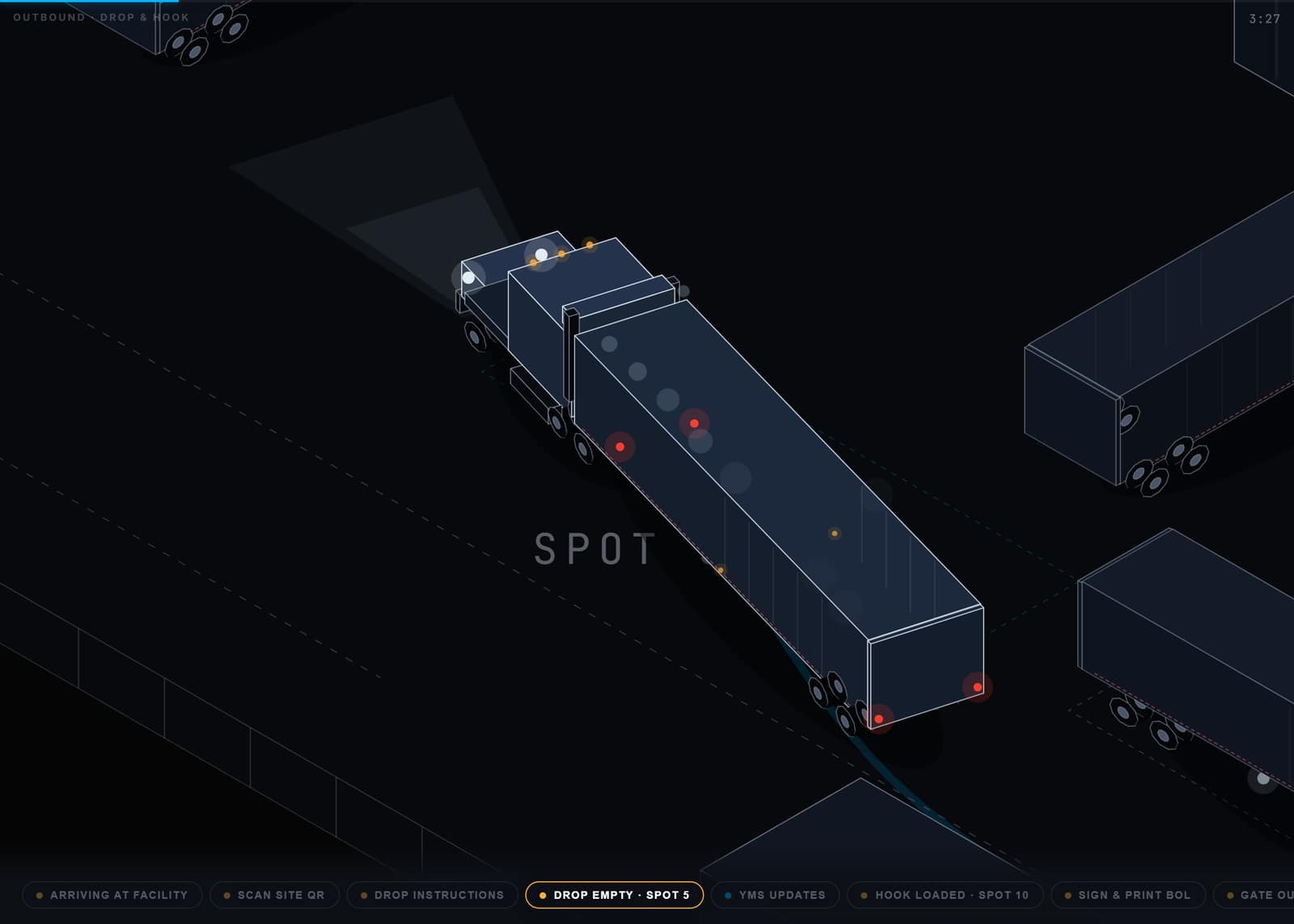
Driver journey first. Digital custody second. YMS orchestration third. Network standardization fourth. Physical automation after that.
Definition / operating sequence
What is a yard automation flow?
A yard automation flow is the dependency sequence that turns manual gate, custody, and move events into machine-readable work before physical automation is added. The sequence is: audit the network; standardize the driver journey and digital custody; orchestrate execution in the YMS; standardize the network; then automate the constrained physical step. The layers may deploy together. The order describes dependencies, not a calendar.
Fix the yards before buying robots
The paper, read and debated by an AI research duo for fifty minutes. The conclusion they reached is the one on this page: sequence the yards first. A paper about sequencing automation, argued by automation.
Listen
Section 00
Executive summary
Yards are becoming the new control point in supply chain execution. Warehouses have been optimized. Transportation has been digitized. Visibility platforms have made freight easier to track in motion. But the yards, the physical handoff between transportation and warehouse execution, are still where plans go to get mugged by reality.
The 2026 State of Dock and Yard Management report, published by C3 Solutions and referred to here as the yard survey, makes the gap obvious. Across its 149 supply chain and logistics professionals, inefficient manual processes remained the top operational challenge at 40.3%. Real-time yard visibility was the leading feature priority at 59.1%. Implementation effectiveness was the leading software satisfaction driver at 55.7%. Sustainability was important or extremely important to 95.7% of respondents, and driver experience to 87.1%. Most telling: 72.7% were exploring dock and yard automation, but only 12.9% already had a plan.[1]
Translation: the market wants automation, but the market is still tripping over the basics.
That is the YardFlow thesis. The first machine-readable workflow in the autonomous yard is not the autonomous yard truck. It is the driver journey.
If a driver still has to wait for a person to check in, receive instructions verbally, return to the dock office, wet-sign paperwork, and wait again to leave, then the yards are not ready for autonomy. They may be ready for another pilot. They may be ready for a press release. They are not ready for network-scale automation.
The bill of lading is part of the same problem. NMFTA describes the BOL as a contract between shipper and carrier, a receipt for shipped goods, and a document of title. Digitizing it is not office hygiene. It is custody infrastructure.[4]
THE WEDGE / boring math, on purpose
The YardFlow conservative paper model starts with the most boring possible math: five to ten cents per page in direct cost, three pages saved per shipment, moving from nine pages to six by eliminating the shipper's paper copy. That is fifteen to thirty cents per shipment before any labor, storage, retrieval, dispute, detention, or driver-experience value is counted. At 250 shipments per site per day, 260 operating days, and 24 sites, that direct paper reduction is roughly $234,000 to $468,000 a year and 4.68 million pages avoided.[13] Even the top of that range is a floor, not the model: estimates that load in years of document storage and retrieval put the true cost of a page several times higher. The full economics live in the YardFlow ROI model.[3]
That is the wedge. Save the trees, save the driver time, save the dock office from the paper chase, and give the YMS a clean custody event it can actually use. That is how the autonomous yard starts.
The wedge is the entry point, not the prize: behind it sits realized production capacity, about 5% more volume observed across the sites running the driver-journey layer at Primo, worth $1M+ in incremental profit per site.[19]
Key takeaways
- 01The autonomous yard is a sequencing problem, not a robot-first problem.
- 02The driver journey is the first machine-readable workflow.
- 03The digital BOL is custody, not admin hygiene.
- 04A great YMS is the execution brain, and it gets stronger when fed clean driver, custody, and exception events.
- 05Sustainability and driver experience improve through the same operating motion: fewer manual handoffs, fewer paper exits, less idling exposure, and cleaner custody.
Personalized AI summary
Pick your seat and get the three points that matter most to it. Grounded only in this paper.
Fig. 01 / The 2026 yard survey: dock and yard signals
The signals point to workflow-first automation, not robot-first theater.
Source: the 2026 yard survey of 149 supply chain professionals.[1] Percentages are reported survey findings.
Section 01
The yards are where supply chain plans meet physics
Every supply chain strategy eventually reaches the yards.
A driver arrives. A load needs to be picked up or delivered. A trailer needs to be found. A door needs to be assigned. A seal needs to be captured. A BOL needs to be signed. A spotter needs to move something. A dock team needs to know what is next. A transportation team needs to know whether the carrier is at risk. A warehouse team needs to know whether the appointment is still real.
This is where the digital plan touches the physical world. It is also where the mess shows up. The yard survey calls dock and yard operations the place where supply chain plans meet real-world variability, and notes that performance increasingly influences transportation reliability, labor productivity, and customer outcomes.
The yards are not a parking lot. They are the enterprise's physical API. And in too many networks, that API is a person with a clipboard.
Section 02
The automation market has an order-of-operations problem
Automation is not the enemy. Bad sequencing is.
There is nothing wrong with autonomous spotters, machine vision, RTLS, unmanned gates, algorithmic dispatch, robotic yard moves, or a serious YMS. In the right operating model, those tools compound value. But if they land on top of unstandardized workflows, they inherit the chaos.
A robot cannot fix a wet-signed BOL. A camera cannot standardize check-in instructions. A YMS cannot orchestrate the yards if the arrival, custody, status, seal, and exception events feeding it are late, local, incomplete, or trapped inside conversations.
This is where many automation programs get sideways. They buy the thing that looks like the future before they build the operating model that lets the future work. The better question is not, can we automate this move. It is, have we standardized the workflow this automation depends on.
Automation does not fix unstandardized yards. It inherits them.
Fig. 02 / The YardFlow sequence
Turning the yards from analog workflow into automation-ready infrastructure.
01Driver journey
Turn arrival, identity, instructions, signature, seal, and exit into structured events.
02Digital custody / flowBOL
Make the BOL timestamped, searchable, digital, and tied to the real yard event.
03YMS orchestration
Let the YMS run on cleaner operational events instead of local improv.
04Network standardization
Create common definitions, KPIs, rollout logic, and enterprise-level comparability.
05Physical automation
Add machine vision, RTLS, unmanned gates, and autonomous yard moves where the economics are obvious.
Fig. 03 / The sequence, mapped
The ladder above says the order. This map says what each phase actually produces. The spine compresses to three words, audit, optimize, automate; run as a program, the middle expands into three gates: optimize the handoffs, orchestrate the YMS, standardize the network. Automation stays gated until the four phases before it have run.
01 Audit
- Map the driver flow
- Map the dock and paper flow
- Map the exception flow
02 Optimize
- Digitize check-in and instructions
- Digitize BOL custody
- Standardize exception handling
03 Orchestrate
- Run the YMS on clean driver and custody events
- Live yard status and move dispatch
- Exceptions cleared before they breach
04 Standardize
- Common definitions and KPIs across sites
- Site scorecards and cross-site comparability
- The network rollout playbook
05 AutomateGATED
- Machine vision
- RTLS and autonomous moves
- Network-wide automation
01 Audit
- Map the driver flow
- Map the dock and paper flow
- Map the exception flow
02 Optimize
- Digitize check-in and instructions
- Digitize BOL custody
- Standardize exception handling
03 Orchestrate
- Run the YMS on clean driver and custody events
- Live yard status and move dispatch
- Exceptions cleared before they breach
04 Standardize
- Common definitions and KPIs across sites
- Site scorecards and cross-site comparability
- The network rollout playbook
05 Automate · GATED
- Machine vision
- RTLS and autonomous moves
- Network-wide automation
First principles
Automate last is not a slogan. It is an engineering law.
The order of operations is not a YardFlow invention. It is the same first-principles rule that runs SpaceX and Tesla. Elon Musk's five-step engineering algorithm runs in strict sequence: question every requirement, delete the part or process, simplify, accelerate, and only then automate. Automation is step five. The rule is that it comes last.
Musk learned it the hard way. He tried to automate the Model 3 line before deleting and simplifying it, fell into what he called production hell, and later called excessive automation his own mistake, adding that humans are underrated.
“The big mistake was that I began by trying to automate every step. We should have waited until all the requirements had been questioned, parts and processes deleted, and the bugs were shaken out.”
The yards are the same problem. Audit the requirements, delete and standardize the manual handoffs, then automate. Automate first and you scale the mess.
Section 03
Automation should compound the operating model, not rescue it
Automation should compound a working operating model, not rescue a broken one. Point a robot at late custody events, a guessed trailer location, and exception logic buried in phone calls, and it scales the mess instead of the fix.
This is why automation cautionary tales should be read carefully. They are not proof about yards. They are proof about sequence. The same pattern shows up across two decades, four industries, and billions of dollars: automation scaled on top of an operating model that was not standardized, not proven, or not ready to generalize past the showcase facility.
Fig. 04 / The pattern: automation before the operating model
Different eras, different industries, one sequencing error. Driverless yard trucks are deploying into Fortune 500 yards right now, so the yards are next in line for this mistake, unless they are sequenced first.
2001
2019
2025
Webvan
Dot-com collapse
Committed to 26 automated distribution centers before one had proven profitable, and collapsed eighteen months after its IPO.[12]
Adidas Speedfactory
Both plants closed
Two highly automated factories in Germany and the United States could not scale past a fraction of a percent of production. The showcase never became the network.[11]
Kroger and Ocado
Roughly $2.6 billion
Kroger moved to close three automated Ocado fulfillment centers and pulled e-commerce back toward stores after the automated network missed its financial expectations.[10]
Webvan
2001Dot-com collapse
Committed to 26 automated distribution centers before one had proven profitable, and collapsed eighteen months after its IPO.[12]
Adidas Speedfactory
2019Both plants closed
Two highly automated factories in Germany and the United States could not scale past a fraction of a percent of production. The showcase never became the network.[11]
Kroger and Ocado
2025Roughly $2.6 billion
Kroger moved to close three automated Ocado fulfillment centers and pulled e-commerce back toward stores after the automated network missed its financial expectations.[10]
None of these is a result from the yards, and none should be used as one. The lesson is the sequence. Automated does not automatically mean scalable. A flagship site is not a network strategy. A robot is not a protocol. A dashboard is not an operating model. The next impairment charge in this pattern will be written against a network that bought the robot before it built the workflow. Build the yards a robot can read. Then let the robot compound.
Section 04
The market data supports the sequence
The yard survey data does not say companies need more technology in the abstract. It says they need technology that can be implemented, integrated, adopted, and measured inside the real workflow.
Manual processes remain the top challenge. Real-time visibility remains the top feature priority. Integration and scalability are rising. Implementation effectiveness matters more than features, support, or price. Sustainability and driver experience are now embedded in vendor evaluation. And while nearly three-quarters of respondents are exploring automation, only a small minority already have a plan.
That is the whole market in one sentence: everyone wants automation, almost nobody has sequenced the operating model. The report's own recommendations reinforce the point: create internal alignment before buying technology, treat integration as a first-class priority, make implementation a competitive advantage, simplify vendor selection with operational criteria, and elevate driver experience to an operational KPI.
Fig. 05 / One dot per respondent
The C3 sample as an honest unit chart: 19 of 149 lit, the have-a-plan share, and it is shrinking year over year.
19 of 149 have a plan. 12.9%. About one in eight.
And shrinking
−6.5
points
Section 05
The driver journey is the first machine-readable workflow
The autonomous yard starts when the driver arrives. Not when the robot moves. The driver journey is where identity, appointment, load intent, instructions, safety acknowledgment, seal capture, dock interaction, BOL signature, exit validation, and custody all converge.
In a manual yard, that workflow is a sequence of handoffs: the driver pulls up, waits for a guard or dock-office employee, identifies themselves, confirms the load, receives instructions, finds the drop or hook, returns to the office, provides seal information, wet-signs paperwork, takes copies, leaves one behind for the shipper, waits again, and exits. That is not just friction. That is unstructured operational data.
YardFlow's public product framing points to the better model: flowDRIVER lets drivers check in from their phone with no app, no guard, no clipboard, while flowBOL creates a digital, timestamped chain of custody. YardFlow frames the broader product as one unified yard network, not disconnected yard islands.
That is why the driver journey comes first. It turns the yards' noisiest human handoff into structured events: arrival, instruction, signature, seal capture, and exit.
The driver journey is the first machine-readable workflow.
Fig. 06 / The same arrival, two operating models
The manual handoff chain against the standardized driver journey, as event logs. 48 minutes in, 24 out.
Section 06
The digital BOL is not admin. It is custody infrastructure.
Paper is easy to underestimate because each sheet looks cheap. That is the trap. A paper BOL is not expensive because of the paper. It is expensive because of the workflow wrapped around it.
Someone prints it. Someone signs it. Someone prints another. Someone files it. Someone retrieves it when there is a claim, detention dispute, chargeback, OS&D issue, customer question, or audit request. That is not documentation. That is latency with a staple in it.
NMFTA's definition matters because it reminds everyone what the BOL actually is: a contract, a receipt, and a document of title. It is not back-office fluff. It is the shipment's custody instrument.[4] The Digital LTL Council eBOL API Standard describes eBOL as a way to digitize, streamline, and standardize the BOL process, eliminating paper-based inefficiencies and enabling more automated, accurate documentation, with fewer manual errors, better shipment visibility, and faster workflows.[5]
That is exactly the YardFlow wedge. The digital BOL is the point where sustainability, driver experience, compliance, and system readiness all touch the same workflow.
Paper is just the beginning of the story. It is identifiable and quantifiable, making it easy pickings for CFOs to underwrite. We estimate that paper is less than 10% of the overall savings opportunity.
Paper is the first payback wedge. Not because printer paper is expensive. Because every paper BOL creates a handling tax.
Fig. 07 / Conservative direct paper savings
A YardFlow model, direct paper only. Five to ten cents per page, three pages saved per shipment, 260 operating days, 24 sites. It excludes labor, storage, retrieval, claims, disputes, detention, and cleaner YMS input value.
YardFlow conservative model. Formula: 3 pages saved x $0.05-$0.10 x shipments x 260 days x 24 sites. Direct-paper only. Full economics: yardflow.ai/roi.
Section 07
Sustainability and driver experience are the same move
A lot of sustainability programs die because they are treated like a reporting exercise. A lot of driver-experience programs die because they are treated like a vibes exercise. The yards give both of them a better path.
Reduce the manual handoffs and the same move reduces paper, dock-office congestion, driver waiting, unnecessary idling, detention exposure, document ambiguity, and system noise. That is not ESG confetti. That is operational physics.
The yard survey says sustainability is now mainstream in vendor evaluation, with 95.7% of respondents rating it important or extremely important. Driver experience is important or extremely important to 87.1%, and the survey connects driver wait times, communication quality, and yard flow to carrier relationships and service reliability.[1]
EPA's SmartWay program connects reduced truck idling to fuel savings, lower greenhouse gas emissions, reduced air pollution, and better air quality around facilities and docks.[7] FMCSA connects detention to operational and safety issues: a prior FMCSA study found detention on roughly one in every ten stops, averaging 1.4 hours beyond the two-hour standard, and cited a 2018 OIG study finding that a 15-minute increase in average dwell raised expected crash rate by 6.2%, and that every one-minute reduction in average detention nationwide could prevent roughly 400 crashes a year.[6]
This is where the paper stops borrowing authority and points at its own stopwatch. In a field-validated side-by-side pilot at a Primo Brands site, YardFlow's standardized workflow cut drop-and-hook turn time from 48 minutes to 24 on the same gate, the same trucks, the same days, and that protocol now runs across all 24 of Primo's live sites. The compression sits in the wait, the gate queue and the dispatch lag, not in the physical move. Halve the time a truck spends on site and you shrink both the window it can idle in and the window a detention clock can run against it. So the idling EPA ties to fuel and emissions, and the dwell FMCSA ties to detention and safety, stop being two more programs to fund. They are the same recovered minutes, counted once. And the driver who keeps those minutes is the driver who stays, which matters when long-haul truckload turnover runs near 90% a year (ATA).
Carriers price how the yards treat them. Ryan Soskin, an early Convoy leader now running GoodShip, has described how Convoy's driver app let carriers rate each facility one to five stars, and recalled one market where carriers averaged around 4.6 stars while a given shipper's facilities ran near 2.6. His point was blunt: if carriers do not like going somewhere, that eventually gets "reflected in the price."[18]
YardFlow does not claim every national detention, emissions, or safety benefit as its own. That is how vendor math turns into a pumpkin at midnight. The point is stronger: when the yards reduce paper exits, dock-office handoffs, driver waiting, and idling exposure, sustainability and driver experience improve through the same operating motion.
Operational physics is only physics if you measured it. At Primo, the same move cut the turn from 48 minutes to 24, on the same gate.
Fig. 08 / The sustainability and driver-experience flywheel
Paper reduction and driver experience are the same workflow improvement seen through different lenses.
Section 08
The YMS is not the enemy. The YMS is the execution brain.
This point matters. The argument is not that a YMS is bad. That would be wrong, and strategically dumb. A great YMS is the execution brain the yards run on. But even the best YMS needs clean inputs from the real world.
If arrival data is trapped at the guard shack, seal capture is on paper, dock instructions happen verbally, trailer status is updated late, and exceptions live inside phone calls, the YMS is forced to orchestrate around local chaos. That is not a software problem. That is an input problem.
This is why the order of operations matters: driver journey first, digital custody second, YMS orchestration third, network standardization fourth, physical automation after that. The verified deployment context supports the sequence: the driver journey is live at 24 Primo Brands sites, and flowYMS is deployed at 10 of those 24. In an observed comparison, the driver-journey sites moved about 5% more volume than comparable sites without the layer, on the same dock-office headcount.
First, digitize the front door. Then, clean the custody trail. Then, orchestrate the yards. Then, standardize the network. Then, automate the physical work. The YMS gets stronger because the workflow under it gets cleaner. That is the whole game.
A great YMS is the yards' execution brain. It just needs clean inputs from the real world.
Deployment note, from the field
The sequence is a dependency order, not a calendar. At a new network, YardFlow now deploys the driver journey and the YMS together, as one wholesale change, because separate rollouts force unnecessary integrations. Primo took the layers in sequence only because the YMS did not exist yet, and that sequencing is also why the 5% comparison exists at all: sites running the driver journey could be measured against sites without it. Deploying together does not reorder the logic. The YMS orchestrates on driver and custody events from day one, which is exactly why the driver journey is the first machine-readable workflow.
Fig. 09 / The verified deployment context, measured
Before and after standardization, field-validated in the Primo side-by-side pilot. The protocol now runs across 24 live sites.
Both numbers are measured. In the Primo pilot, YardFlow ran its workflow beside the legacy workflow at the same site and timed every check-in in parallel: the same trucks, the same days, the new process clocked against the one it replaced. The 48 is the legacy stopwatch, the 24 is YardFlow's, on the same gate. The compression is in the wait, the gate queue and the dispatch lag, not in the physical move, which takes the same time in both.
Production receipts / measured at the source
1M+
Driver Check-Ins
0.2%
Failure Rate
200K
Drivers Onboarded
Your software enabled us to take on additional volume while remaining headcount neutral in the dock office. That was an integral part of our strategy, and it has been proven.
BENCH / The industry ruler
Drop-and-hook turn time against the public freight ruler. Minutes at the gate, on the same trucks.
$36
truck and driver cost back, every turn
24 minutes recovered at the ATRI truck-hour rate
39.3%
of stops end in driver detention
ATRI detention research
$3.6B
ATRI direct detention cost, a year
plus 11.5B more in lost productivity
near 90%
long-haul truckload turnover, a year
ATA; the detained driver is the driver who quits
For scale: average driver dwell runs about 98 minutes (ATRI, 2024), and YardFlow's operating target for a standardized drop-and-hook turn is under 30. At roughly $90 per truck-hour (ATRI 2025 Update), 24 minutes recovered per turn is about $36 of truck and driver cost back every turn, before detention and capacity. Drivers are detained on 39.3% of stops, which ATRI puts at $3.6 billion in direct cost and $11.5 billion in lost productivity a year. That 39.3% and the FMCSA one-in-ten figure cited earlier are honest together because they measure different yardsticks: FMCSA counted detention events running past the two-hour standard, while ATRI surveys drivers on the detention they report at any length, so detention touches somewhere between 10% and 39% of stops depending on the ruler. Detained drivers are the drivers who quit: long-haul truckload turnover runs near 90% a year (ATA), so every hour lost in unstandardized yards feeds a retention crisis, not just a cost line.
Section 09
Network standardization is where the value compounds
One site improves with a tool. A network improves with a protocol. That is the difference between yard management and a Yard Network System.
YardFlow's public positioning is blunt: you do not have 50 yards, you have one standardized yard network. YardFlow is the standardized operating protocol that turns the gate and the yards into one deterministic system.
That language matters because the enterprise buyer is not really buying a better gate app. They are buying fewer local exceptions, a common operating model, and the ability to compare one site to another without first arguing over what a turn means. A turn is a turn. A wait is a wait. A missed appointment is a missed appointment. A signed BOL is a signed BOL. A detention risk is a detention risk.
That is how network operators move from visibility to control. Visibility tells you what happened. A network protocol tells the operation what to do next.
Section 10
The YardFlow Readiness Index
Before buying the next automation layer, score the network across six flows. This is not a vanity score. It is a sequencing tool. It tells the network what to fix first, what can wait, and where automation strands if it is bought too early.
Fig. 10 / Yard Automation Readiness Index
Score the network across six flows before buying the next automation layer.
The 2026 yard survey: only 12.9% have a plan, 40.3% call manual processes their #1 challenge
Mostly manual, like most of the field. Automation here strands. Standardize the weakest flow first, before any robot.
Standardize first
- Kill the paper shuffle. Digital, timestamped chain of custody (flowBOL).
- Get the data deterministic enough to orchestrate, the gate for any robot (flowAI and flowNETWORK).
Section 11
Recommended rollout model
The rollout should not be sold as a software install. It should be sold as a network standardization program with evidence gates. Each phase earns the next by producing proof, not slideware.
Fig. 11 / Rollout sequence with evidence gates
A standardization program, not a software install. Each phase exits on proof. Phases are dependency gates, not calendar quarters: at a new network the driver journey and the YMS ship together.
01 Audit
- Select three sites that do not look alike: a plant, a banner DC, and a highly automated facility
- Score the driver, dock, paper, exception, and automation-runway flows
Exit / Current-state map, readiness score, paper baseline, driver-friction map, automation sequence
02 Optimize
- Launch the driver journey
- Launch flowBOL, the digital custody layer
- Standardize exception handling
Exit / Digital check-in, digital signatures, paper reduction, fewer dock-office touches
03 Orchestrate
- Turn on YMS orchestration where driver and custody events are clean
- Confirm integration with WMS, TMS, and reporting
Exit / YMS event completeness, live yard status, move orchestration, exception aging
04 Standardize
- Roll out common KPIs and definitions across sites
- Rank sites by readiness and ROI
Exit / Common definitions, site scorecards, rollout playbook, cross-site comparability
05 Automate
- Add machine vision, RTLS, and heavier autonomy where the evidence justifies it
Exit / Machine vision, RTLS, unmanned gates, autonomous spotting, algorithmic dispatch
01 Audit
- Select three sites that do not look alike: a plant, a banner DC, and a highly automated facility
- Score the driver, dock, paper, exception, and automation-runway flows
Exit / Current-state map, readiness score, paper baseline, driver-friction map, automation sequence
02 Optimize
- Launch the driver journey
- Launch flowBOL, the digital custody layer
- Standardize exception handling
Exit / Digital check-in, digital signatures, paper reduction, fewer dock-office touches
03 Orchestrate
- Turn on YMS orchestration where driver and custody events are clean
- Confirm integration with WMS, TMS, and reporting
Exit / YMS event completeness, live yard status, move orchestration, exception aging
04 Standardize
- Roll out common KPIs and definitions across sites
- Rank sites by readiness and ROI
Exit / Common definitions, site scorecards, rollout playbook, cross-site comparability
05 Automate
- Add machine vision, RTLS, and heavier autonomy where the evidence justifies it
Exit / Machine vision, RTLS, unmanned gates, autonomous spotting, algorithmic dispatch
Section 12
The proof package buyers should demand
Executives should not buy an autonomous yard as a concept. They should demand evidence that the yards are becoming more machine-readable.
The proof package should include current pages per shipment, paper reduction per shipment, digital BOL rate, driver check-in time, dock-office touches per shipment, gate-to-gate time, YMS event completeness, trailer status freshness, exception aging, detention exposure, idle exposure, and volume moved on flat headcount.
The YardFlow ROI model computes board-ready economics for an entire yard network, including Year 1 ROI, payback period, five-year NPV, and per-facility savings. It separates hard savings such as detention, demurrage, gate labor, spotter utilization, and BOL handling from realized production capacity.
For this public paper, the paper math is intentionally conservative. The paper wedge alone is useful because it is easy to understand and hard to argue with. The rest of the model is where the steak shows up, priced against your real network, ready when the buyer is.
Section 13
Objections and rebuttals
The likely executive objections, and the sales-safe rebuttals that hold up under scrutiny.
Fig. 12 / Objections and rebuttals
Sales-safe rebuttals for the most likely executive objections.
“We already have a YMS.”
Good. In how many of your sites? The same one everywhere, or a patchwork of local installs? Is it interoperable and AI-native, one Yard Network System across the network? Usually not. So the real question is whether that YMS is getting clean data from the real workflow. A YMS is the execution brain. It should not be forced to hallucinate reality from paper, radio, and late updates.
“Paper savings are too small.”
Per shipment, yes. At network scale, no. And the bigger value is not the paper bill. It is the handling tax, driver delay, custody ambiguity, document retrieval, dispute friction, and cleaner system data.
“Driver experience is soft.”
No. The yard survey says driver experience is important or extremely important to 87.1% of respondents, and FMCSA connects detention to earnings, safety, and supply chain efficiency.[1][6] That is not soft. That is freight.
“Sustainability is reporting theater.”
It can be. But not here. If a workflow reduces paper, dock-office handoffs, unnecessary waiting, and idling exposure, sustainability becomes an operating result, not a slide.[7]
“We should start with robotics.”
Maybe, but only after the yards can feed the robot deterministic workflows. Otherwise the robot becomes a very expensive participant in the same broken process.
“Automation failed at a big retailer, so automation is risky.”
Wrong lesson. The better lesson is that automation economics depend on fit, sequence, and scale. Automated and scalable are not synonyms.[10]
A note on claims
How to read this paper.
This paper is built to be public-safe and source-backed. The yard survey figures come from the 2026 report as published.[1] The BOL and eBOL claims come from NMFTA and the Digital LTL Council. The detention, safety, and idling figures come from FMCSA and EPA. The automation cautionary tales are public company events. Where a number is a YardFlow figure, it is labeled as one.
The paper-savings model is a clearly labeled YardFlow conservative model, direct paper only, always stated with its shipment counts and assumptions. It is a floor, not a forecast. The full, buyer-specific economics live in the YardFlow ROI model, priced against your real network.
The deployment context is verified: the driver journey is live at 24 Primo Brands sites, flowYMS is deployed at 10 of those 24, and in an observed comparison the driver-journey sites moved about 5% more volume than comparable sites without the layer. Primo took the layers in sequence because the YMS did not yet exist; new networks deploy the driver journey and the YMS together. The cautionary tales are adjacent lessons about sequence, not yard-automation proof.
Conclusion: build the yards a robot can read
The autonomous yard does not arrive as one big capital project. It arrives as a sequence.
First, the driver journey becomes digital. Then, custody leaves the file cabinet. Then, the YMS orchestrates cleaner events. Then, the network standardizes performance. Then, physical automation compounds on top. The sequence is the dependency graph, not the install calendar: at a new network the layers ship together.
That is the order. Not because robots are bad, but because robots are late-stage leverage. The autonomous yard starts with the first machine-readable workflow.
That is how yards become readable. That is how a network becomes standard. That is how automation stops being a showcase and starts becoming infrastructure. Audit the network. Optimize the workflow. Then automate the work.
Thesis / in one line
Standardization is the strategy. Automation is the option it earns.
Pick a time and you are on the calendar.
Thirty minutes, direct with Casey Larkin. Pick an open time below and you are booked.
None of these times work? Email me at casey@yardflow.ai or call or text me at 410-236-7434, and we’ll find one.
Casey Larkin, YardFlow. Jake Koppinger, our founder, joins when it helps.
The official report, as one file. Built for screens, shareable anywhere.
Download the report (PDF)Cite this paper
72.7% of supply chain professionals are exploring yard automation in 1-2 years; only 12.9% have a plan, down from 19.4% the year before.
The 2026 yard survey (C3 Solutions), n=149Inefficient manual processes are the #1 yard challenge for 40.3% of supply chain professionals, up from 35.9% year over year.
The 2026 yard survey (C3 Solutions), n=149At peak, 51.0% reach for overtime and 50.3% for temporary labor; only 34.2% reach for technology.
The 2026 yard survey (C3 Solutions), n=14955.7% say implementation effectiveness, not features or price, decides whether yard software delivers.
The 2026 yard survey (C3 Solutions), n=149In a side-by-side pilot at a Primo Brands site, drop-and-hook turn time compressed from 48 minutes to 24. The standardized protocol now runs across 24 live sites.
YardFlow, Primo Brands network
The marginal cost of trucking is about $90 per truck-hour (ATRI 2025 Update), so 24 minutes recovered per turn is roughly $36 of truck and driver cost back every turn.
ATRI, An Analysis of the Operational Costs of Trucking: 2025 UpdateDrivers are detained on 39.3% of stops, which ATRI puts at $3.6 billion in direct cost and $11.5 billion in lost productivity a year (2023 data; published 2024).
ATRI, New Research Documents Substantial Financial and Safety Impacts from Truck Driver Detention (2024)The most advanced autonomous-trucking programs are deliberately running the easy, bounded highway miles first, leaving the yards for later.
Associated Press, via WESA (2024)Kroger wrote off roughly $2.6 billion unwinding its Ocado automated-fulfillment expansion in late 2025, closing three fulfillment centers.
Grocery Dive, November 2025Driverless yard trucks entering Fortune 500 deployment in 2026 are engineered against more than 200,000 yard-specific hazards.
Outrider (TÜV SÜD-validated), 2025Gartner projected at least 30% of generative-AI projects would be abandoned after proof of concept by end of 2025, largely due to poor data quality.
Gartner, July 2024
Electronic bills of lading deliver faster processing and streamlined operations, reduced paperwork and administrative costs, and improved data accuracy.
NMFTA, What Is a Bill of LadingThe Digital LTL Council eBOL API Standard is a unified framework to digitize and standardize the creation, transmission, and management of bills of lading across the LTL industry.
Digital LTL Council (NMFTA), eBOL API StandardCanonical: https://yardflow.ai/order-of-operations/
Press kit: the op-ed, ready to run
Everyone is selling autonomous yards. The order of operations is backwards.
Autonomous yards have a sequencing problem, and the bill is coming due. In late 2025 Kroger wrote off roughly $2.6 billion unwinding its Ocado robotic-fulfillment bet. Tesla burned through Model 3 production hell over-automating a line before it was simplified. Adidas closed its automated Speedfactories when they could not scale past the showcase. The most advanced autonomous trucking programs are deliberately running the easy highway miles first and leaving the yards for later. The pattern is consistent, and it is not a hardware story. The robots work. The operating models underneath them do not.
The 2026 State of Dock and Yard Management survey (C3 Solutions) of 149 supply chain professionals found the tell hiding in plain sight: 72.7 percent are exploring yard automation in the next one to two years, and only 12.9 percent have a plan. Almost everyone wants the payoff. Almost no one has sequenced the work.
There is a correct sequence. Audit the workflows across the network. Optimize the manual handoffs into one standard protocol, starting with the driver journey and the paper, then layer in the YMS to orchestrate the yards on clean, deterministic data. Then, and only then, automate the physical work. The order matters because automation inherits the yards it lands in. Stack a robot on an analog operation, where a driver still hands paperwork to a guard and wet signs a three-part bill of lading, and you get an expensive island of automation that cannot compound across the network. You get tech density, not operational control.
In a side-by-side pilot at a Primo Brands site, standardizing the yards compressed drop-and-hook turn time from 48 minutes to 24 on the same gate. The protocol now runs across 24 sites. Half the turn time is synthetic capacity, and the half that vanished was wait, not movement. That is more volume on the same footprint, realized production capacity with no new concrete. It is also the foundation that finally makes the robots worth buying, because they plug into yards that already know the workflow they automate.
The lesson is not that automation is wrong. It is that automation is the last step, the option standardization earns, not the first. Standardization is the strategy. The companies that sequence the work, that audit and optimize before they automate, will compound an operational advantage the 87 percent without a plan will struggle to close. The robots are coming. The question is whether the yards will be ready to use them.
Contact and full report: yardflow.ai/order-of-operations
References
- [1]C3 Solutions, The State of Dock and Yard Management 2026. c3solutions.com ↗
- [2]YardFlow by FreightRoll, public homepage and product framing. yardflow.ai ↗
- [3]YardFlow ROI model. yardflow.ai ↗
- [4]NMFTA, What Is a Bill of Lading in Shipping. nmfta.org ↗
- [5]Digital LTL Council (NMFTA), eBOL API Standard. dsdc.nmfta.org ↗
- [6]FMCSA, Impact of Driver Detention Time on Safety and Operations. fmcsa.dot.gov ↗
- [7]US EPA SmartWay, Idle Reduction. epa.gov ↗
- [8]Walter Isaacson, Elon Musk (Simon & Schuster, 2023): the five-step algorithm and the Model 3 automation mistake.
- [9]CNBC, Elon Musk admits humans are sometimes superior to robots (April 2018). cnbc.com ↗
- [10]Grocery Dive, Kroger acknowledges that its bet on robotics went too far; three automated fulfillment centers closing, roughly $2.6 billion impairment (November 2025). grocerydive.com ↗
- [11]CNN Business, Adidas is closing hi-tech sneaker factories in Germany and the US (November 2019). cnn.com ↗
- [12]Webvan, Wikipedia (2001 collapse; 26 automated distribution centers committed before proof of profitability). en.wikipedia.org ↗
- [13]YardFlow deployment context and conservative paper-savings model. Driver journey live at 24 sites; flowYMS deployed at 10 of those 24; paper model: $0.05-$0.10/page in direct material cost, 3 pages saved per shipment. Fully loaded estimates that include multi-year document storage and retrieval run several times higher per page.
- [14]TechCrunch, Amazon halts Blue Jay robotics project after less than six months (February 2026). techcrunch.com ↗
- [15]DHL Supply Chain, Insight 2030 Supply Chain Leaders Survey: 44% deployed warehouse robotics, 34% of executives fully satisfied (November 2025). dhl.com ↗
- [16]CFO Dive, Warehouse robot forecast lowered as retail correction persists (Interact Analysis, December 17, 2024). cfodive.com ↗
- [17]ACT Research, Trucking Industry Forecast for 2026: structural capacity tightening. actresearch.net ↗
- [18]The Freight Pod, Episode 85, host Andrew Silver with Ryan Soskin (early at Convoy, now founder and CEO of GoodShip): carriers rated facilities in the Convoy app, and low facility ratings get reflected in the price carriers charge. buzzsprout.com ↗
- [19]YardFlow ROI model, the v2 Archetype Network Model, derivation of the $1M+/site figure. It is a conservative modeled floor, not a survey result: a site moving about 5% more volume on the same dock-office headcount and the same dock doors, valued at real margin per truckload. Bottled water runs lower margin than most shipping categories, so the per-site figure is conservative for the category. Full, buyer-specific derivation is priced against a real network in the ROI model. yardflow.ai ↗