Prepared for The Coca-Cola Company · ~270 sites · one network standard
You automated inside the building. The yards are the half that is left.
You automated the warehouse. The dock door is where it stops.
Coca-Cola Consolidated opened a $90 million automated distribution center in Columbus, running the Vertique system inside the building. The robots stop at the dock door. Outside it, the yard is the one part of that flow your stack cannot see, so the rest of it plans against a guess. YardFlow is the Yard Network System, the software layer between your TMS and your WMS. The automation you bought inside the building ends at the dock, and every load still starts and ends at a gate. Primo Brands has implemented the driver journey system wide, cut trailer turn times by 50%, and shipped about 5% more volume on the same dock-office headcount. The audit shows where the same gain sits in your network.
- $238.5M/yr
- modeled across the network
- $4.3M/yr
- added contribution margin per site
- 3.2 mo
- payback, before rollout completes
- The gapEvery yard is an island. The rest of your stack plans against a guess.
- The network layerOne system of record across every yard. Live truth into your TMS, WMS, and plan.
- Production capacityMore volume on the same footprint. No capex, no new heads.
- ProvenPrimo committed all ~260 sites to the protocol; 26 live today. Turns cut 48 to 24 at the live sites.
The problem
You do not run one yard. You run a network of about 55, and it is not connected.
Here is the part no planning system can see.
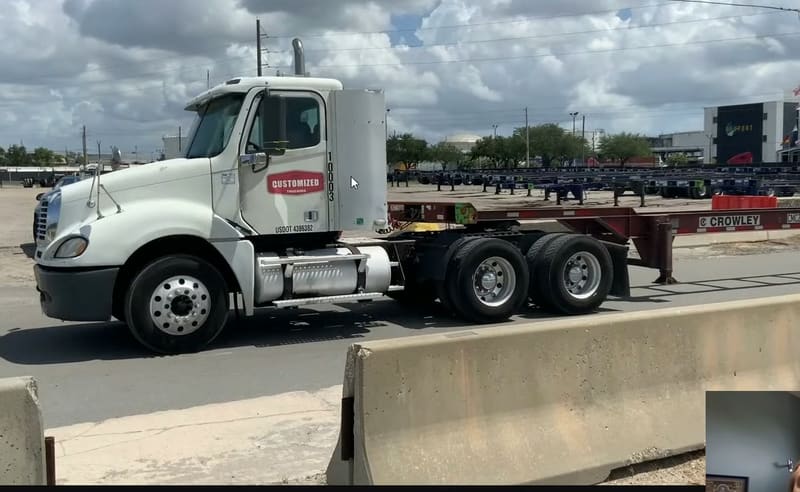
Your TMS knows the truck on the road. Your WMS knows the freight inside the building. Between them sits the yard. Across roughly 55 sites, that is a network of disconnected islands. Some run a legacy system. Our read is that most run on whatever each site worked out for itself, and that none of it is one standard. You would know. Columbus proves the point. The Vertique system automated the picking inside that new $90 million building. Outside it, 60 dock doors still funnel through one truck gate. The robots feed a dock the yard cannot keep loaded. So the choke moved to the gate, not the building. Every upstream system you bought assumes it knows where the trailer is. In a yard with no network, the schedule is a guess. That is the gap. You can see it on the ground. A driver climbs down to ask a human where to drop. Three bill-of-lading copies print for one shipment. A trailer sits lost on your own concrete. Those are the symptoms. The disease is that your yards were never on the network. Every other tier of your supply chain is connected. The yards are the last one that is not. Routing, SKU velocity, and delivery windows all run to the minute. A blind yard turns a dock delay into a missed route. We mapped 30 of your US sites from satellite to show the pattern. 27 of those 30 already run drop yards, where the 48 to 24 minute drop-and-hook win lands.
Why now
You just spent $90 million automating inside. The yard is the next constraint.
Columbus shows the trajectory.
You put the Vertique system inside the building, and the picking got faster. The dock now waits on the yard. A faster dock with a blind yard simply queues trucks at the gate. The capital you spent inside the building only pays off when loads clear the yard. A networked yard is the cheapest capacity you will ever add. It turns drop and live loads sooner and frees dock hours. Peak volume moves through the same sites with no new concrete. That is production capacity you create, not capacity you buy. Every dollar you spent on automation keeps underdelivering while the yards stay blind. All of it assumes a trailer position the yard cannot confirm. 25 of your 30 audited sites burn dray on every inbound, with only 5 on rail. A networked yard turns those moves faster first. The longer the yards stay off the network, the more that silo tax compounds.
Who we are
The Yard Network System. The network layer your stack was missing.
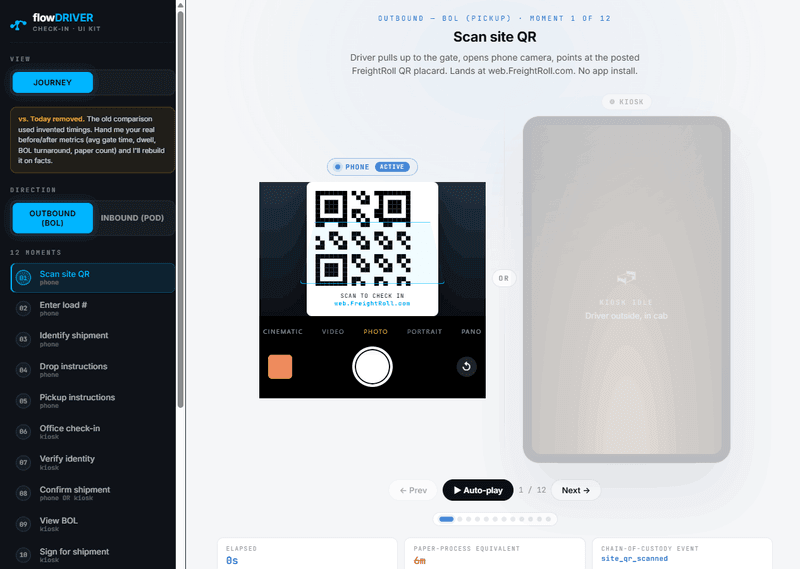
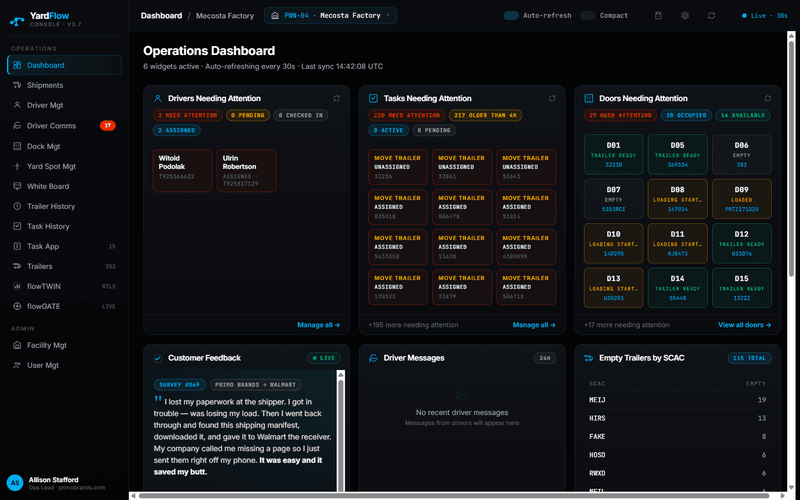
Every yard runs the same jobs, and the same people run them. The Yard Network System gives each of them one standard across every site. The driver checks in from their phone with flowDRIVER. The spotter moves the trailer while computer vision in the cab maps the yard with flowVISION. The dock coordinator assigns the door from flowYMS. The dock office signs the BOL with flowBOL. The executive watches every yard on flowNETWORK. Under all of it, machine vision reads the truck at the gate and an agent dispatches the next move. Think EZ-Pass at the gate and air-traffic control for your trailers.
The proof · already at scale
This is the way. We are just getting started.
The point is not faster trucks. It is realized production capacity: 5% more volume out the door on the same headcount, capacity those plants could not ship before.
Primo started with one layer: the driver journey. Text the truck instead of checking it in. Paper out of the gate. No more driver-to-dock-office handoff. Across the sites where it went live, those yards shipped about 5% more volume than the sites without it, on the same dock-office headcount. That alone is why Primo committed all ~260 sites to the full Yard Network System, the first national shipper to standardize every yard on one protocol. The YMS is rolling now. Live at 10 plants, every production site by the end of Q3. The 5% came from the lightest touch. The rest is still ahead. Coca-Cola would be the first beverage network at this scale to take it.
“Your software enabled us to take on additional volume while remaining headcount neutral in the dock office. That was an integral part of our strategy, and it has been proven.”
Result measured on the driver-journey layer, before the YMS rollout. Primo is live at 10 plants today, every production site by the end of Q3.
Your own audit
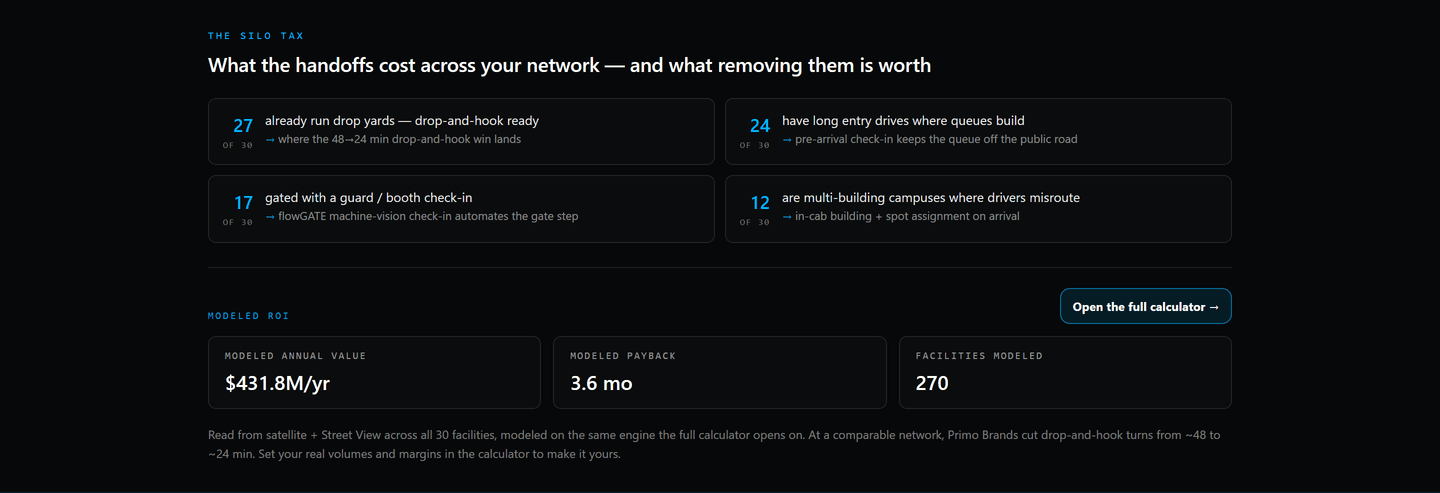
This is Coca-Cola’s own audit, not a generic benchmark. We mapped 30 US bottling sites from satellite. Here is what the handoffs cost across the network.
- 27 of 30
- Already run drop yardswhere the 48 to 24 minute drop-and-hook win lands
- 24 of 30
- Long entry drives where queues buildpre-arrival check-in keeps the queue off the road
- 17 of 30
- Gated with a guard or boothflowGATE automates check-in and exit
 See all 30 sitesOpen the audit →
Easy
We are not asking for a pilot. We are asking for a conversation.
A 30-minute call, direct with Casey. Nothing gets ripped out to start. We will not tell you which site to start at. We have only seen your yards from orbit. You run them, so you already know which one goes first. We show you what we found, you tell us straight where it fits. If the call goes well, we talk about where that is, on economics that legacy YMS never allowed. If not, you keep the analysis.
- 01Audit30 minutes. We show you what we found on your network.
- 02Your readYou tell us where we are wrong. You run the yards; we do not.
- 03ThenIf it fits, we talk about where to start. You would pick that, not us.
The brief, one more time
- The problemThe yards are the last tier of your stack with no network, run site by site across the bottler network.
- The proofPrimo is retiring its legacy YMS and committed all ~260 sites to one protocol. More volume, flat headcount, measured at the live sites.
- The prize