
Every restaurant owner knows the money is not in the tables. It is in the turns. A table that sits twenty minutes waiting for its check is a table you do not have, and no owner in the country answers that problem by building a bigger dining room.
American trucking has been building the bigger dining room for as long as it has been talking about a driver shortage.
In November 2021, David Correll of MIT's FreightLab told the House Transportation and Infrastructure Committee that the driver shortage is not a shortage but a problem of chronic underutilization of the drivers we already have. He had analyzed the working hours of about 4,000 over-the-road drivers. The law allows them 11 hours a day behind the wheel. They drive about six and a half. Much of the rest is spent waiting at shippers and receivers, and by his arithmetic 40 percent of America's trucking capacity is left on the table every day. The number that should have ended the argument came next. Not the four and a half hours. Just 18 more minutes of driving per driver per day, he said, could close the gap the industry calls a shortage. His phrase for the cause was not a lack of drivers. It was "an endemic undervaluing of our American truck drivers' time."
The capacity is already here. It is parked at the dock, with a driver in it, waiting.
What the wait costs, and what the turn is worth
The American Transportation Research Institute (ATRI) put a price on the wait in 2024. In 2023, drivers reported being detained in 39.3 percent of all stops. ATRI's estimate of what detention cost the industry that year: $3.6 billion in direct expenses and $11.5 billion in lost productivity. More than fifteen billion dollars for standing still.
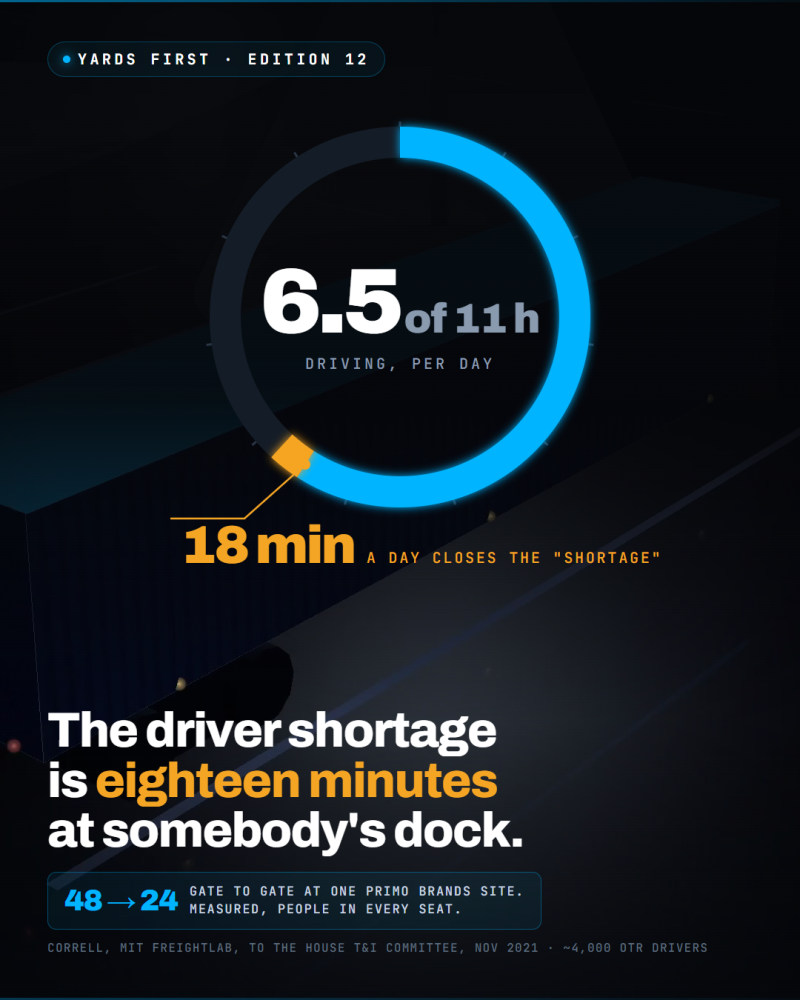
We measured the other side of that ledger. At one Primo Brands site, gate to gate fell from 48 minutes to 24 after we standardized the driver workflow: one check-in from the driver's phone, one digital bill of lading (BOL), the trailer waiting where the text said it would be. That is 24 minutes handed back to a driver at a single stop, against the 18 a day Correll said would close the gap. Across the sites where that workflow went live, we observed about 5 percent more volume on flat headcount, from the driver check-in and the digital BOL alone. Same people. No robot. The capacity was there the whole time, and we watched it come out as the waiting went away.
That is the entire idea. Respect the truck, turn it fast, and the capacity you were about to buy turns out to be already on the property.
The truck that never sleeps
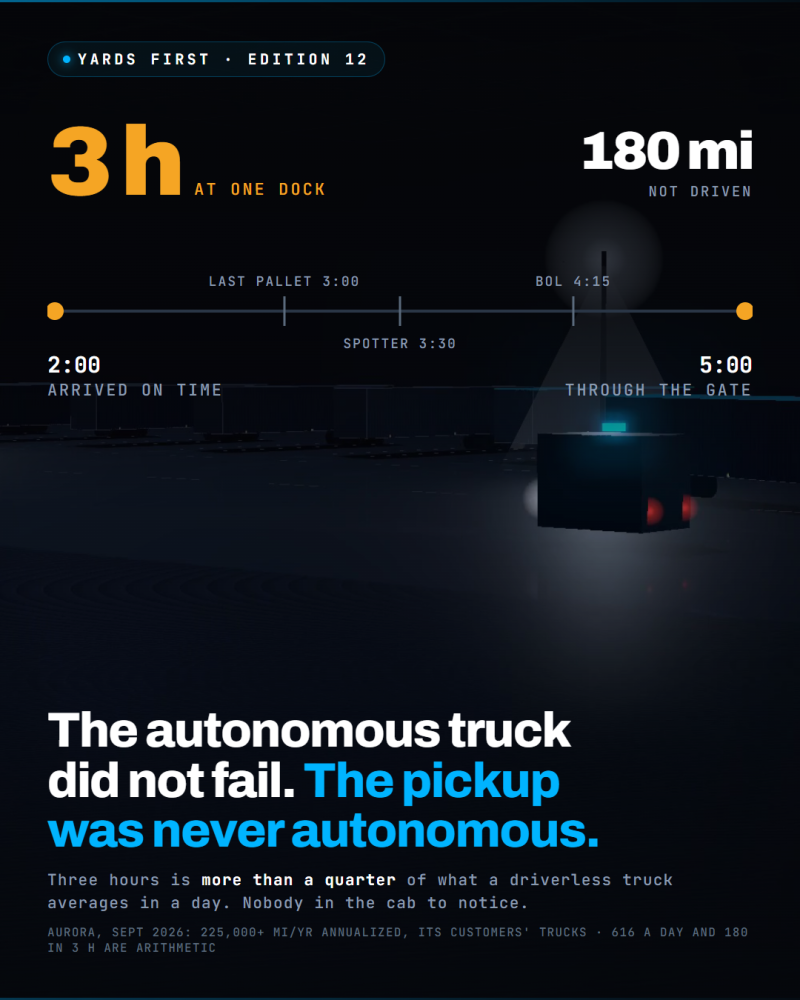
Now look at what the industry is building instead. In September, Aurora reported passing 500,000 driverless miles, and said the trucks operating for its customers with the Aurora Driver are averaging an annualized rate of more than 225,000 miles a year, more than double the utilization of a traditional truck. Aurora's numbers, not mine. That is about 616 miles for every day on the calendar. A truck with nobody in it has no 14-hour duty clock, no rest period, no home time. It gives back the hours the rules took from the driver.
It gives back none of the hours the dock took. Park that truck outside a distribution center at 2 p.m. for a scheduled pickup, and the trailer is not ready. The last pallet goes on at 3, the spotter pulls the trailer at 3:30, the BOL clears at 4:15, and the truck leaves at 5. Three hours is about 180 miles at highway speed, more than a quarter of what that truck averages in a day, and there is no longer a person in the cab whose wasted afternoon makes the loss visible.
The autonomous truck did not fail. It arrived exactly on time, at a pickup that was never autonomous.
Most driverless freight today dodges the question by running terminal to terminal, with a person draying the trailer the last few miles. The lane Volvo Autonomous Solutions and Aurora opened in May hauls straight to customer facilities, still with a person in the cab, which is the industry saying it would rather not pay for that person forever.
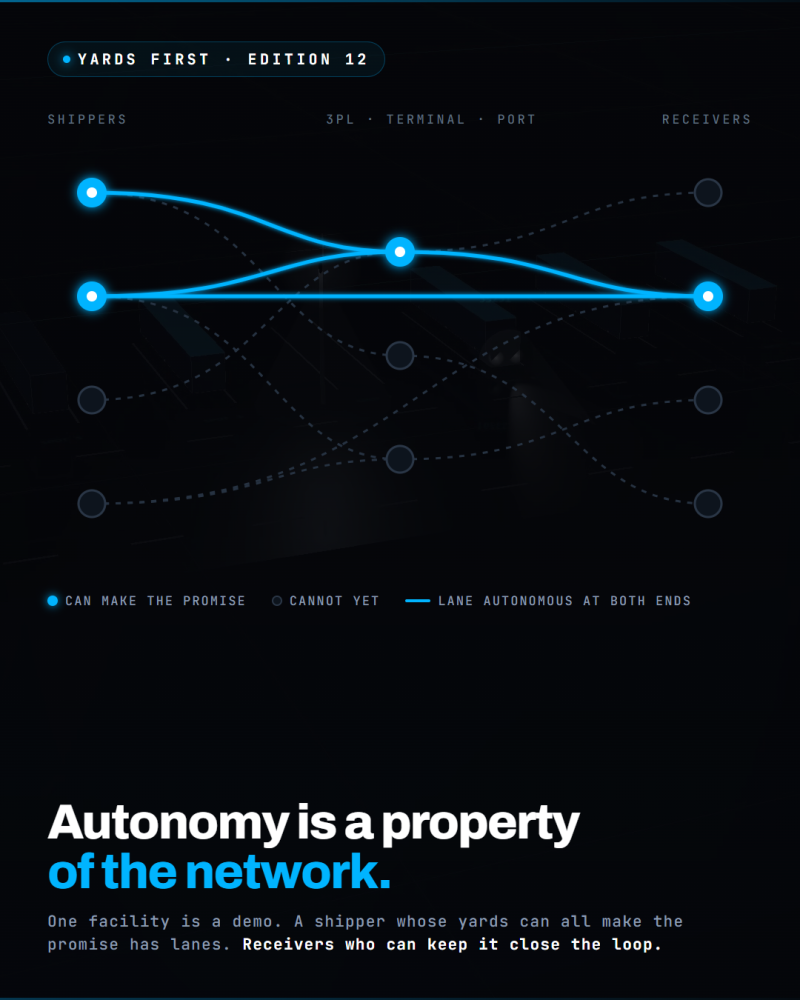
Autonomy is a property of the network
A freight movement is not a drive. It is a chain of handoffs: a shipper's dock, a yard spot, a gate, the highway, a receiver's gate, a receiver's door, and often a 3PL's cross-dock, a carrier's terminal, a rail ramp, or a port along the way. Every link is a node in somebody else's network, and the truck's day is the sum of all of them. The drive is the link the industry chose to automate first. The driver was the glue in every other one, asking which trailer, reading the seal, signing the BOL, and noticing when the trailer at door 7 is not the one on the paperwork. The driver is the error handling. Take the driver out and every exception that used to be quietly caught lands on the facility, in real time, with a very expensive machine waiting on the answer.
So a movement is not autonomous because nobody is driving. It is autonomous when every handoff on its route can be completed without the driver, on a record both sides trust. That is a different thing from putting a few driverless trucks on a lane between two yards that happen to be ready and calling the operation autonomous, and the difference is where the money is. Autonomy compounds the way networks compound. One facility that can make the handoff is a demo. A shipper whose yards can all make it has turned its outbound freight into lanes a driverless truck can run door to door. When its receivers can do the same, the lane is autonomous at both ends, and the hours the dock took come back with nobody in the cab to lose them. The truck companies have built the vehicle that can accept that promise. Shippers and receivers own the networks that have to make it.
What the yards have to be able to say
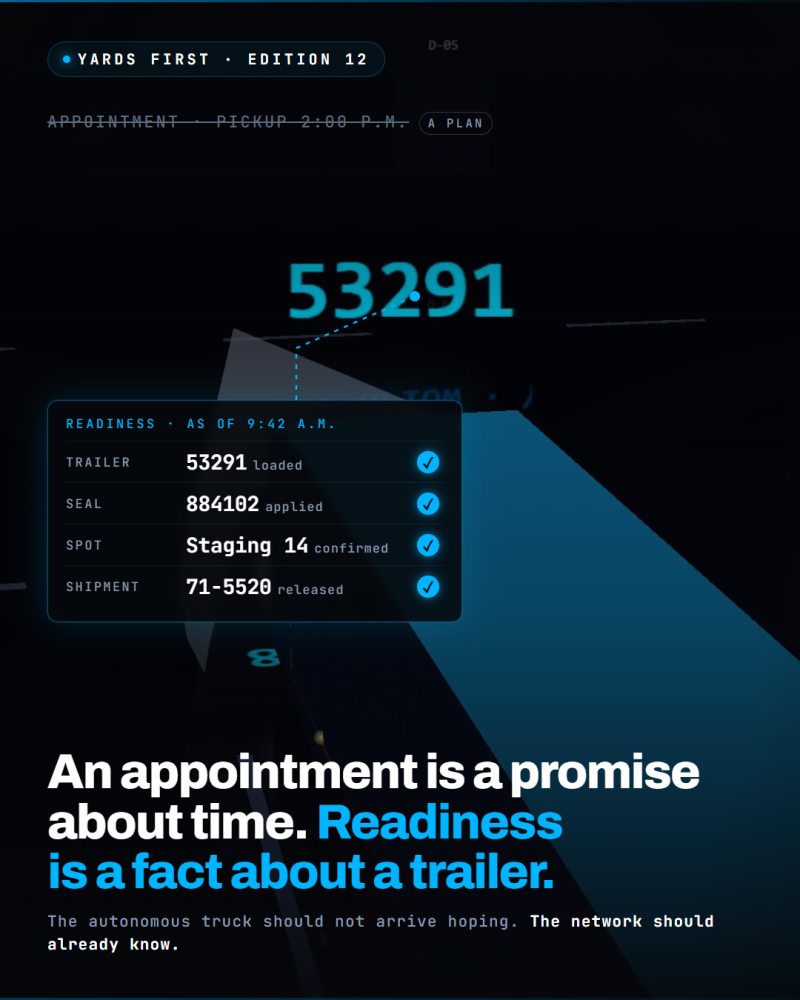
Most large shippers already run software that knows a truck is coming: what was tendered, what is shipping, who is due at 2, which door. Each holds a piece of readiness, and none of them is the promise. An appointment is a promise about time. Readiness is a fact about a trailer: "trailer 53291 is loaded, sealed with seal 884102, parked in staging spot 14, released for pickup under shipment 71-5520, as of 9:42 a.m." Every clause is a physical event that either happened or did not, and it has to be true before the truck commits to the load. A human driver wants that sentence just as badly. The autonomous truck should not arrive hoping its freight is ready. The network should already know.
Many yards cannot say that sentence, because their records cannot. We recently analyzed yard inventory records across several sites of one large shipper, all on the same yard management system. One record in eight had no location at all: the system knew the trailer was on the property and could not say where. Dozens of trailers had been on the record for more than a month, a handful for more than a year. And the share of records with no location varied eightfold between sites of the same company on the same software. A record that cannot place one trailer in eight cannot promise anyone anything, and the spread between sites says the fix is operational, not another purchase.
It already runs, and no standard had to come first
Here is what the promise looks like at the Primo Brands yards running on our system today, with people in every role. The dock coordinator assigns an empty trailer to a door, and that one act creates the spotter's move task and locks the yard spot and the door. In most cases "start loading" and "complete loading" are not entered by anyone in the yards; they fire from the warehouse system as the warehouse does its work. When loading completes, the system creates the staging move on its own and frees the door, and the spotter confirms the exact spot. The driver has checked in by phone and been texted that spot and the seal number. At check-out the driver signs, and the digital BOL is in hand before the gate. Every move is a timestamped event with a who, a what, and a when. The readiness statement is not a new feature. It is the current state of a record that already exists.
People hear "digital BOL" and reach for a data standard. The National Motor Freight Traffic Association's Digital LTL Council has published one for the electronic bill of lading in less-than-truckload freight, and others exist. They are not the prerequisite. A standard defines the document. It does not make the trailer ready or create the moment it changed hands. Agreeing on one data model across the largest shippers and re-architecting every ERP to match it is real work, and nobody has to wait for it. Custody is an operational event: a specific trailer changed hands at a specific moment. The yards have to produce it on the day for every load, and once it exists it can travel alongside the BOL data in whatever format the parties already exchange.
Our system already produces that event for a human driver: identity, shipment, trailer, seal, signature, time. For an autonomous truck, the same event would become an exchange of timestamped messages between the facility's record and the truck's fleet system, written onto the digital BOL the facility already produces, doing the job the driver's signature does today on a sealed, shipper-loaded trailer: acknowledging that this truck took custody of this trailer, under this seal, at this time, on whatever terms the shipper and the carrier agree to. Federal law has not stood in the way since 2000: a record may not be denied legal effect solely because an electronic agent helped create or deliver it, so long as the agent's action is legally attributable to the person bound by it. What the parties accept is in their contract. What remains on the record side is an integration between two systems that both already know how to keep one.
The standard is not the prerequisite. The record is.
Respect the truck
None of this depends on autonomy. It is what the yards were always supposed to do, made undeniable by a machine that cannot tolerate the alternative. A driver turned in 24 minutes instead of 48 gets 24 minutes of the day back, at one stop, against the 18 a day Correll said would close the gap. Nobody can promise every one of those minutes becomes a mile. Every one of them spent at the dock is guaranteed not to. A driverless truck turned in 24 minutes gets to be the truck Aurora is describing. The same hours, the same dock, the same fix.
Taking the driver out of the cab gives back the hours the rules took. The hours the dock took are still at the dock. Fix them, and a human-driven fleet wins them back now. Leave them, and they come out of a machine that was bought to never stop.
The trucks are already here. Turn them.
Jake Koppinger, Co-Founder and CEO, YardFlow by FreightRoll
Sources: David Correll's testimony to the U.S. House Transportation and Infrastructure Committee, November 17, 2021, as reported by MIT CTL: ctl.mit.edu/news/freightlab-co-director-gives-expert-testimony-improving-trucking-capacity-congressional and MIT News, April 25, 2022: news.mit.edu/2022/are-supply-chains-stuck-detention-0425. ATRI, "New Research Documents Substantial Financial and Safety Impacts from Truck Driver Detention," September 10, 2024: truckingresearch.org. Aurora Innovation, Analyst and Investor Day release, September 23, 2026: ir.aurora.tech/news-events/press-releases/detail/152/aurora-outlines-2030-vision-to-scale-to-30000-driverless-trucks-at-analyst-and-investor-day. Heavy Duty Trucking on the Volvo Autonomous Solutions and Aurora Dallas to Oklahoma City route, May 5, 2026: truckinginfo.com/news/volvo-autonomous-solutions-and-aurora-begin-dallas-oklahoma-city-route. NMFTA Digital LTL Council standards: dsdc.nmfta.org/apis. 15 U.S.C. 7001 (E-SIGN): law.cornell.edu/uscode/text/15/7001. The yard inventory record analysis is YardFlow's own, 2026. The 48 to 24 result, Yards First Edition 3: linkedin.com/pulse/we-cut-turn-half-smallest-thing-happened-jake-koppinger-vf9fc. The 5 percent result, Yards First Edition 8: linkedin.com/pulse/pilot-worked-why-didnt-travel-jake-koppinger-gngpc.
Reply on LinkedIn, where the comments are (opens in a new tab)