Target · 24 US sites, mapped from satellite
The Yard Network System, by FreightRoll.
You keep adding nodes. Every one inherits the same gate.
In June you opened your ninth food DC, a $367 million build in Thornton, the fourth in three years and the first with consolidation. You run almost all inbound by truck, then push to stores on a tight replenishment clock. We mapped all 24 of your US sites. Only one touches rail, so nearly every load moves by truck through 26 gates. What happens at those 26 gates is the one thing we cannot see from orbit. Our read is that the wait there ripples straight to the shelf.
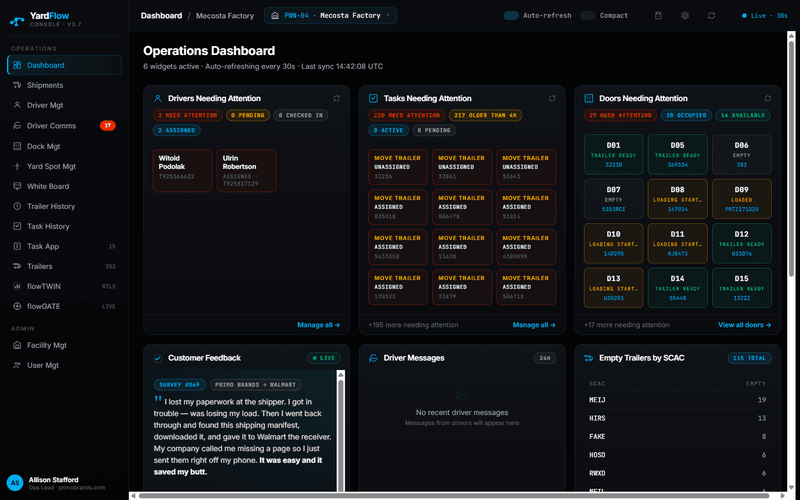
YardFlow is the Yard Network System, the software layer between your TMS and your WMS. Every node you add, every store you turn into a hub, still ends at a gate, a yard, and a dock. We make every yard turn that load fast, on one standard. Primo Brands has implemented the driver journey system wide, cut trailer turn times by 50%, and shipped about 5% more volume on the same dock-office headcount. The audit shows where the same gain sits in your network.
- The gapYour TMS runs the road, your WMS runs the building, nothing runs the yards.
- What we doOne digital standard for all sites. EZ-Pass at the gate, air-traffic control for the trailers.
- The proofPrimo: about 5% more volume on flat headcount, turns cut 48 to 24, and 100% of the network committed.
- The payoffReduce turn times, gain 5% capacity per location. Eliminate paper and detention expenses. No change to headcount.
Already live at scale · the Primo Brands network
The Yard Network System runs the yards behind these household brands. Live today, rolling to 100% of the network.

Using actual results from Primo Brands, we modeled the potential prize for Target.
Proven at Primo, modeled across the network
The problem
Every yard "does it their own way." That is not strategy. That is drift.
Ask two of your sites and we would expect the same line: our yards are different.
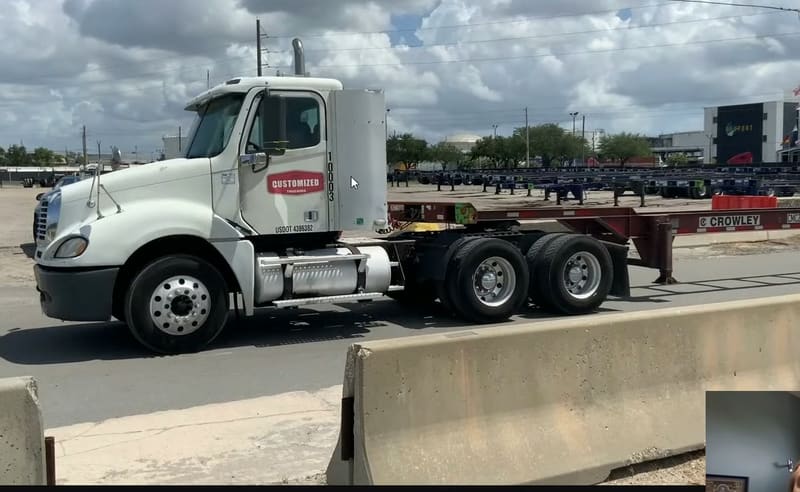
In our experience they are not. Same trucks, same trailers, same moves. What differs is the workaround each site improvised, hardened into a process nobody chose. Rialto crams about 320 dock doors onto a 160-acre import cross-dock, sized like a small port. Our read is that every trailer on it is sequenced by hand, on radios and a clipboard, while containers keep arriving behind it. Lugoff holds 1,200 trailer spots against 238 doors on under 70 acres, the tightest trailer-to-door ratio we measured. Legacy YMS was built to run one site, not a network. Our read is that the rest are flying blind. You would know better than we would.
Why now
The network keeps growing. The yards that waste a driver's day will cap how fast it can.
You added Thornton in June, your fourth food DC in three years.
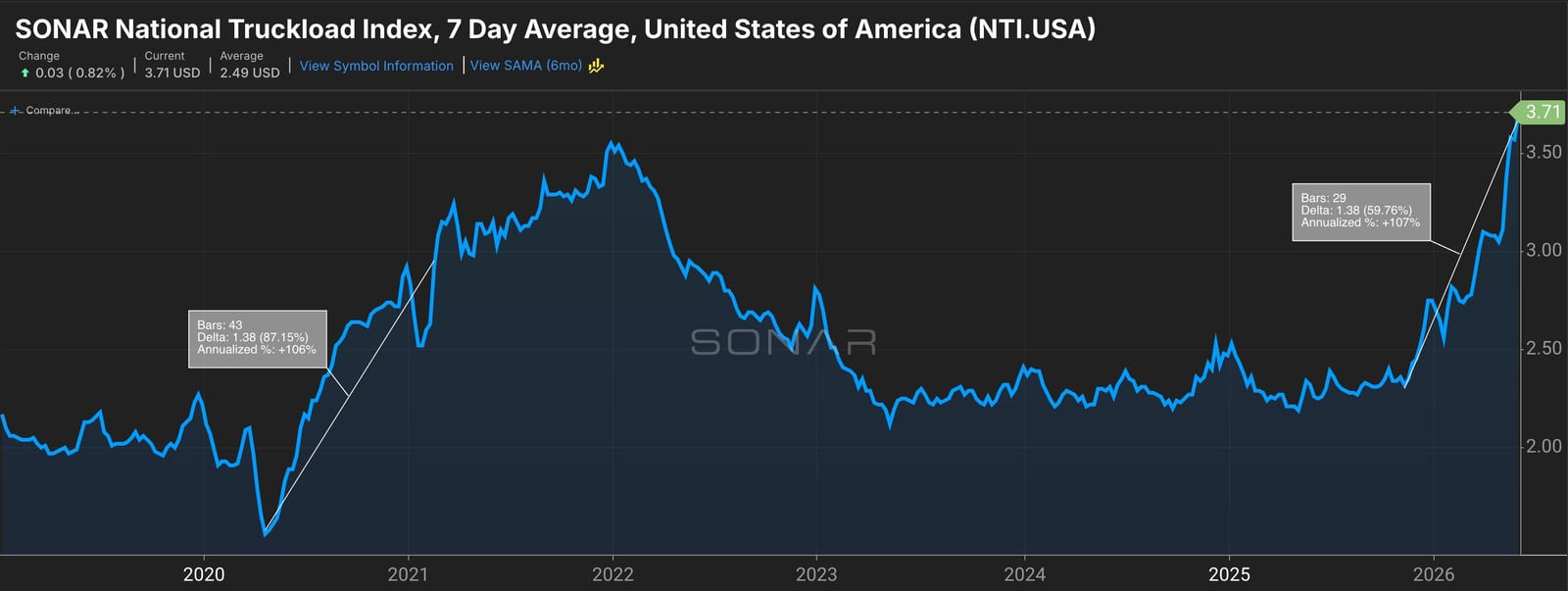
You are growing the sortation network from nine toward more than fifteen by year end. Every new node, every store you turn into a hub, lands on another gate. Our read is that the gate is where your replenishment clock quietly loses its time. The freight cycle is turning too, and pricing power is swinging back to carriers as capacity tightens. The next spot market will punish shippers whose yards burn a driver's afternoon. Detention starts at hour two and runs $50 to $100 an hour, and carriers now pick their shippers. Every printed BOL, every forced check-in, every drop-and-hook instruction, every trailer a driver hunts down is added cost. Fix the yards and the capacity you could not see starts to surface, which is more loads out the same doors. For fresh and frozen the clock is unforgiving. A reefer your yards lose today is shrink this week.
The Yard Network System
A new layer of your stack, between the TMS and the WMS.
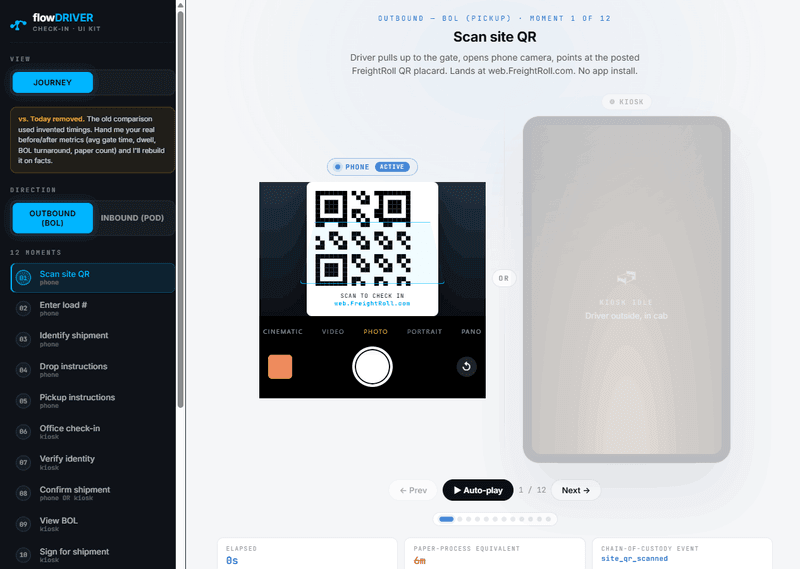
Every yard runs the same jobs, and the same people run them. The Yard Network System gives each of them one standard across every site. The driver checks in from their phone with flowDRIVER. The spotter moves the trailer while computer vision in the cab maps the yard with flowVISION. The dock coordinator assigns the door from flowYMS. The dock office signs the BOL with flowBOL. The executive watches every yard on flowNETWORK. Under all of it, machine vision reads the truck at the gate and an agent dispatches the next move. Think EZ-Pass at the gate and air-traffic control for your trailers.
The proof · already at scale
No company had ever put its whole yard network on one system. Primo just did.
The point is not faster trucks. It is realized production capacity: 5% more volume out the door on the same headcount, capacity those plants could not ship before.
Primo started with one layer: the driver journey. Text the truck instead of checking it in. Paper out of the gate. No more driver-to-dock-office handoff. Across the sites where it went live, those yards shipped about 5% more volume than the sites without it, on the same dock-office headcount. That alone is why Primo committed all ~260 sites to the full Yard Network System, the first national shipper to standardize every yard on one protocol. The YMS is rolling now. Live at 10 plants, every production site by the end of Q3. The highest-volume campus is going fully automated end to end, on a trailer map that updates itself in real time. The 5% came from the lightest touch. The rest is still ahead. Target would be the first national retailer to put its whole yard network on one protocol.
“Your software enabled us to take on additional volume while remaining headcount neutral in the dock office. That was an integral part of our strategy, and it has been proven.”
Result measured on the driver-journey layer, before the YMS rollout. Primo is live at 10 plants today, every production site by the end of Q3.
What it touches
A new layer, not a new migration.
YardFlow runs in the yard and talks to the systems you already have. Your TMS and WMS stay the systems of record. Nobody is ripping anything out.
Built for enterprise infosec review. We connect over your standard API or EDI and scope to yard operations, not your ERP of record. Full integration and security review happen in the audit.
- In the yardflowDRIVER (driver app, no install) and flowGATE (camera gate) run on YardFlow. Nothing changes inside the DC.
- ReadsYour TMS appointments, over standard API or EDI.
- WritesGate and turn events back to your WMS, so dock and inventory stay current.
- IT liftOne connection per system. No rip-and-replace, no platform migration.
Your own audit
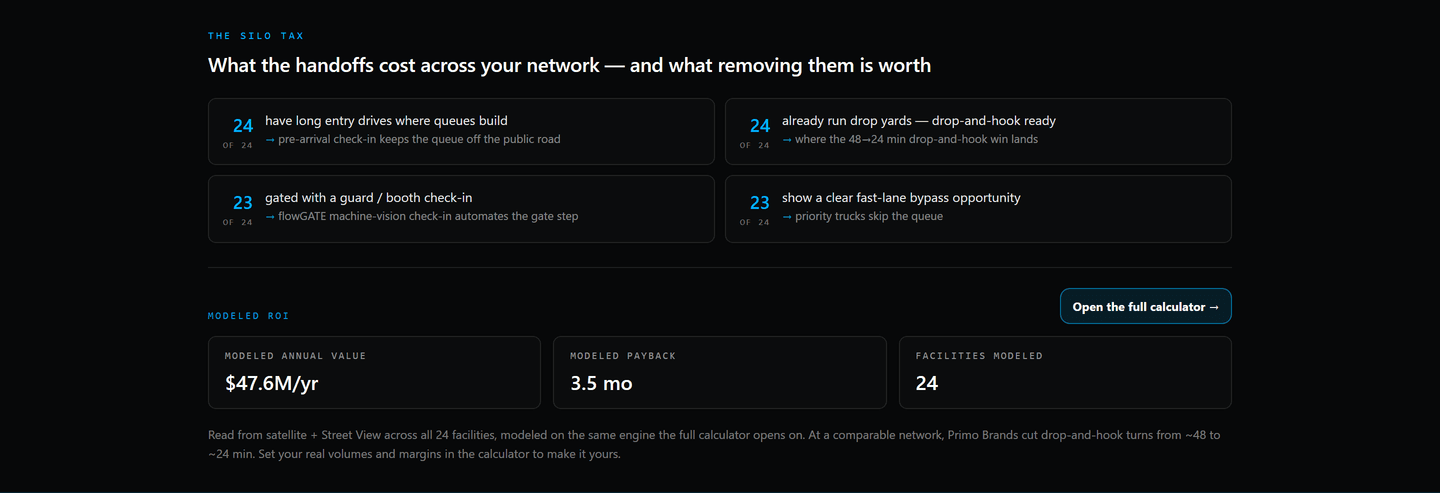
This is Target's own audit, not a generic benchmark. We mapped 24 sites from satellite. Here is what the handoffs cost today, and where the standard lands first.
- 24 of 24
- Already run drop yardswhere the 48 to 24 minute drop-and-hook win lands
- 23 of 24
- Gated with a guard or boothflowGATE automates check-in and exit
- 24 of 24
- Long entry drives where queues buildpre-arrival check-in keeps the queue off the road
 See all 24 sitesOpen the audit →
In short
We are not asking for a pilot. We are asking for a conversation.
A 30-minute call, direct with Casey. We show you what we found on your network, you tell us straight where it fits. We will not tell you which site to start at. We have only seen your yards from orbit. You run them, so you already know which one goes first. If the call goes well, we talk about where that is. If the call does not land, you keep the analysis.
Pick a time and you are on the calendar.
Thirty minutes, direct with Casey Larkin. Pick an open time below and you are booked.
None of these times work? Email me at casey@yardflow.ai or call or text me at 410-236-7434, and we’ll find one.
Casey Larkin, YardFlow. Jake Koppinger, our founder, joins when it helps.