Somewhere in a brokerage TMS there is a facility-notes field with your address in it, something like live unload runs three hours, no overnight parking, call ahead. It is written down. You cannot request it.
The rest of the list is not written anywhere. It is the half second of silence after a carrier rep reads your pickup address to a dispatcher, and the dispatcher decides which of his sixty trucks, if any, is going to eat that afternoon.
Your facilities are on that list or they are not, and no one is going to tell you which.
Eight categories, one handoff
Depending on who you ask, your yards have a detention problem, or a trailer visibility problem, or a dock scheduling problem, or a guard shack problem. Ask three more people and you get a spotter problem, a paperwork problem, a security problem and an automation problem.
Congratulations, we just created eight software categories for one physical handoff.
So I mapped it
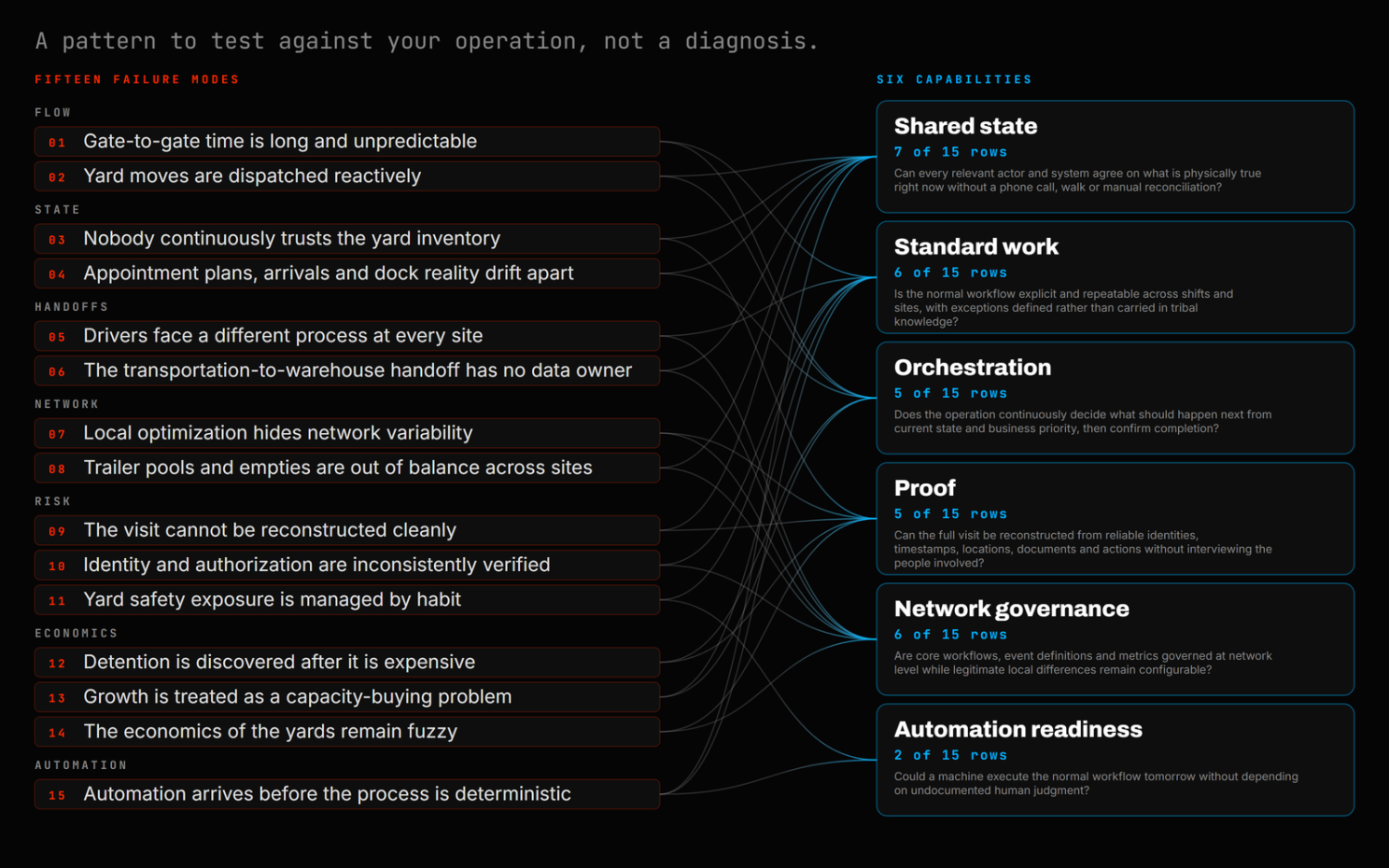
This week I forced the recurring yard problems into a company-agnostic map. Fifteen failure modes, each pushed through the same four questions: what is going wrong, what does the business lose when it happens, what operating condition should we investigate first, and what capability has to exist for it to stop recurring. Problem, Impact, Cause, Solution requirement. The Cause column is written as a hypothesis on purpose. The map is built to be argued with.
I expected fifteen unrelated problems. What I got was the same chain fifteen times. The plans made between facilities and the plans made inside them both have to become physical reality on a few acres of concrete, and on those acres the operation runs on local procedure: radios, spreadsheets, a window, and a person who has gotten very good at making the mess work.
Fragmented state leads to manual coordination, which leads to variable execution, which leaks capacity. Detention is the last link in that chain, which is exactly why it got its own software category and why it is the least useful place to start.
Where the cost actually lives
Last edition made the case that yards are part of your freight rate. The short version: ATRI found fleets get paid on fewer than half of the detention invoices they send, so a small detention bill can sit right next to a very expensive facility. This edition is about where that cost lives, and why nobody in your building owns it.
Jake Koppinger, our CEO, wrote up the carrier's side in Yards First earlier this month, the edition on the five stars you have never seen. He put the memory with the driver, who carries it to the next carrier. My read, from the other side of the desk, is that it also lives with the two people who decide whether you get a truck: the dispatcher, and the broker's carrier rep who has to cover your load when the dispatcher says no.
In a tight market, and Jake's edition covers why we have been in one since July, it plays out like this. Your transportation team tenders a load out of that facility at the contracted rate. The carrier who knows what the pickup looks like rejects it, or accepts it and covers it late with the driver who needs the miles and will not push back, or asks for the appointment to move. The load rolls to the next carrier in the routing guide, then to the broker, who pays over contract to cover it, eats the margin once, and prices it into the next quote. MIT's FreightLab, in a multi-year study with C.H. Robinson's TMC, found that lower dwell at a facility goes with higher tender acceptance. That is the one link in this chain a shipper can pull from a TMS this afternoon.
An afternoon at your dock is next quarter's tender rejection.
Inside the building, the same turn lands on five desks and gets five names. Transportation sees a carrier problem. Operations sees a labor problem. Finance sees another accessorial. The site asks for more equipment. Procurement sees a rate problem two quarters later, on a lane, where geography hides it. Somewhere in a dispatch office, somebody updates the list.
Two places this argument does not reach. Jake already carved out the private and dedicated fleet, where no price mechanism runs and the drivers quit instead. The other one is inbound freight: at many receiving facilities most of the trucks are inbound on the vendor's freight, so the vendor's carrier prices your dock into the vendor's lane and you never see the number at all.
Does it scale?
The autonomy conversation is louder every month, and I am for it. Jake asked the right question about it in Edition 8: what does site twenty get? I want to add the question I ask on calls before that one.
Which parts of this pilot are the same at every facility you own?
Every facility you own does the same short list of things to every truck: check-in, authorization, dock assignment, drop rules, enforcement, compliance, departure, evidence. Every facility also has an exception path, and that is where they stop looking alike, because each site invented its own. The pilot goes to your best site, because that is where the move count is, and then the design gets built around that site's particulars. The exception becomes the spec. That pilot will work. Site twenty then inherits a project built for site one.
The map's fourth column is written as a capability, never a product, and every one of the fifteen is something a network needs at every site rather than a fix for one. Those capabilities are the lowest common denominator across a network. They are also the part nobody wants to demo, because the demo is the robot and the common denominator is a driver checking in from a phone. At Primo Brands that boring layer was the one that earned the whole-network contract; Jake has written that up, and I will not repeat his numbers.
Automate the list every facility shares. Write down the exception path at each site and govern it. Building the robot for the exception gets you a very expensive exception.
Monday morning quarterbacking
Pick the ugliest turn from last week and reconstruct it from property line to property line.
- What did every person and system believe was true at each handoff?
- Where did physical reality and digital reality diverge?
- Which step required somebody to call, radio, walk, search or remember something?
- Who outside your building learned about that turn, and what will they do with it the next time your load is tendered?
- Which steps in that turn happen the same way at every facility you own, and which happened only there?
- If you automated that turn tomorrow, would you be automating the shared steps or the local one?
The full map is here: The Yard Problem Map. Fifteen rows, a diagnostic that starts from the symptoms your people actually see, and every source I used.
The question I would leave with anyone who owns more than a few facilities: does your tender acceptance report have an origin-facility column?
Reply on LinkedIn, where the comments are (opens in a new tab)