Nobody calls a contractor to remodel the kitchen because the faucet drips. You fix the faucet. But if every estimate for the faucet came back as a full remodel, new cabinets, new counters, six weeks of eating takeout, the faucet would keep dripping for years. Not because you like the drip. Because the price of fixing it got bigger than the drip.
Or, say, the yards.
Picture the meeting where technology for the yards finally comes up. Everybody in the room knows the trucks back up every afternoon. Everybody has heard the driver arguing at the window. Then somebody says the word "network," somebody else starts counting sites, and the questions that every operator asks, out loud or not, start piling up. How much is this going to cost? How long before it pays for itself? And do I have to get rid of Jim from security?
Throw on top the fact that the yard is specifically unique because an overhaul touches (and can require approvals from) more parts of the company than almost any other system, save for ERP. WMS mostly touches warehousing, TMS mostly touches transportation. Aspects of yard automation can touch warehousing, transportation, supply chain, back office, dedicated carriers, 3PLs and even vendors / customers. The questions pile up again. Who's in charge of delivery? Who's paying for this? Can you remind me what was wrong with the way our yards operate now?
That is what inertia actually looks like from the inside: a price tag. And the fastest way to shrink a price tag is to focus.
Inertia raises the price
Decisions like this are emotional. Nobody pushes to fix the yards because a spreadsheet told them to; they push because they are tired of the driver fights, the trailer hunts, and the afternoon call from the plant asking where its empties are. But the emotion runs through one question first: what do I get back, and what does it cost me?
If the investment looks too big or the return looks too small, it does not matter how much the problem hurts. The project stalls.
And inertia makes the investment bigger. Harvard's John Gourville found that people overvalue what they already have by about three times, so any change has to clear a bar three times higher than its real cost before anyone signs. Then add the weight of planning a whole network up front: every site, every integration, every committee that wants a say. Each one adds to the price tag before a single truck moves any faster.
So do the opposite. Make the first bite small enough that the return is obvious.
Taking small bites
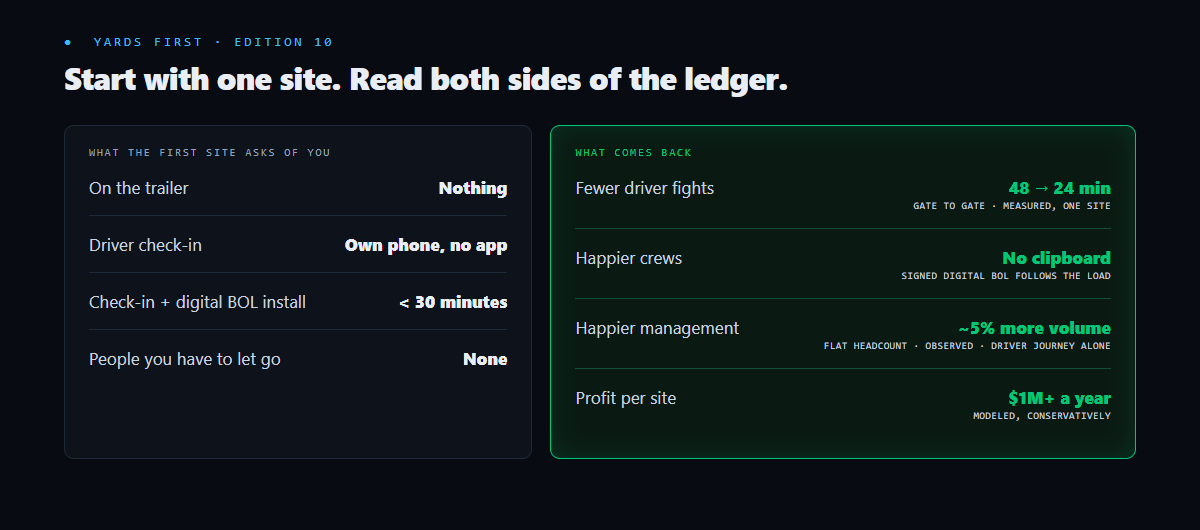
Start with a slice of the overall pie. The truck driver journey, the spotter journey, digital paperwork, trailer visibility...at one site. Focus the decision-making, keep observers apprised, generate viable ROI and work with someone that can show you how to eat the rest of the pie, when the time comes. For example, here is what the first "driver journey" slice asks of you:
Nothing on the trailer: No tags, no readers on every post, nothing to install on the equipment.
Nothing on the driver: He checks in from his own phone, with no app to download. More than 200,000 drivers have done it, over a million check-ins, and not one of them installed anything or received formal training.
Thirty minutes to start: The base system, driver check-in plus the digital bill of lading (BOL), goes in under thirty minutes with minimal training.
You don't have to let Jim go to justify: The check-in happens on the driver's phone, the paperwork happens on a screen, and Jim gets back to keeping the site secure.
I won't put a price in a newsletter, because it depends on your site. What I will say is that it is priced against one site, not a network, and the first conversation is about whether that one site pays for itself, in your numbers, not ours.
Automation that pays is about getting more out of the people you already have. The crew decides whether the first site works, and they will push for the second one if the first one made their day easier.
What comes back
Now the other side of the ledger. Here is what the system returned at one site, in the terms people actually feel.
Fewer driver fights: The driver wants three things: get in, drop the load, and get back on the road. At one site we measured gate to gate falling from 48 minutes to 24. Half the wait leaves a lot less to argue about at the window.
Happier crews: Nobody at the guard shack is on the phone with the dock. The BOL is signed on a screen and follows the load, so nobody digs through a clipboard to find it. Retire the clipboards. Add a camera in the spotter cab on a later bite, and the spotter stops driving laps looking for a trailer.
Happier management: Against comparable sites, we observed about 5% more volume on flat headcount, from the driver check-in and BOL alone. Same people, more freight out the door. Modeled conservatively, that is worth more than a million dollars a year per site in profit from recovered production capacity.
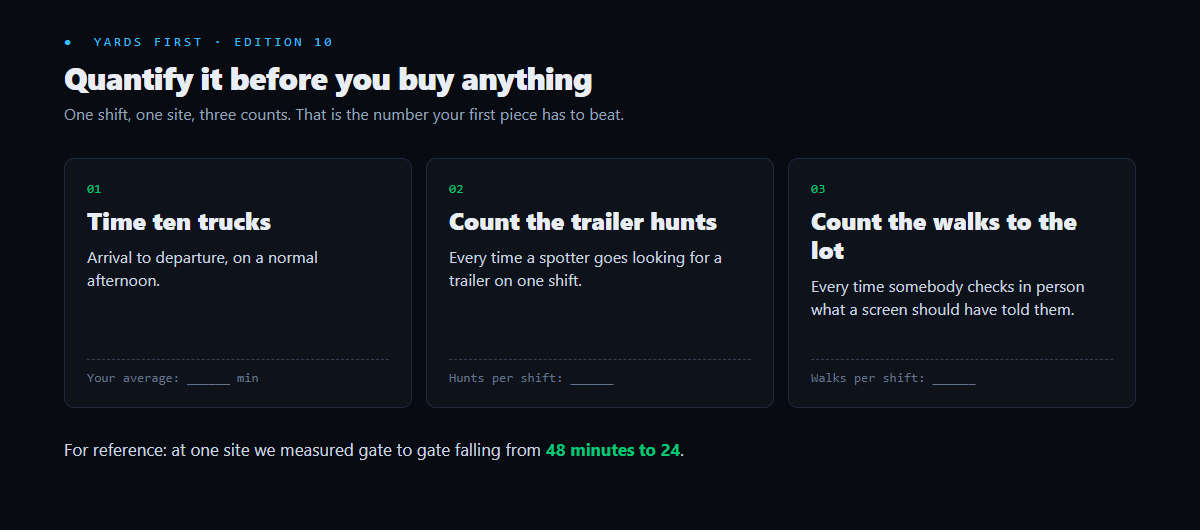
How do you quantify it for your own yards? Start before you buy anything. Time ten trucks from arrival to departure. Count the trailer hunts on one shift. Count the times somebody walks out to the lot to check something a screen should have told them. That is your baseline.
Then do the math three ways. Minutes saved per truck, times trucks a day, is the wait your drivers stop fighting about. Hunts per shift, times the minutes each one takes, is crew time handed back. And if the yards are what cap how much leaves the building, the volume you could ship with the same crew is the number your plant manager will care about. Put those three next to what the first site costs. That is the whole business case.
Then take the next bite
Once the first site works, the next decision gets smaller. The next site runs the same check-in, the same BOL, and the same map, and the people at the first site become your best references. That is how momentum works inside a big company: one result that people can see makes the next yes easier.
If the day comes that you want to talk about the whole network, we have you covered: Primo Brands has 260 sites under one contract with us, on one standard. But that is a conversation for later.
You start with one site. Reply and tell me which one you would pick, and what it costs you today. I would bet the fix is smaller than the drip.
Jake Koppinger, Co-Founder and CEO, YardFlow by FreightRoll
Reply on LinkedIn, where the comments are (opens in a new tab)