The McDonald brothers ran one very good hamburger stand in San Bernardino. Ray Kroc did not buy the hamburger. He bought the fact that a sixteen-year-old in a town he had never visited could make it the same way on a Tuesday night with neither brother in the building.
Or, say, a yard system that runs beautifully at the one site where the vendor's engineers spent ninety days, and cannot get out of the parking lot.
One of the big issues we see in the market right now is yard automation that does not scale. Not automation that does not work. Most of it works, at the site where it was installed, with the crew that was asked to make it work. The trouble starts at site two, and it was decided long before that, in how the thing was designed.
The industry is already telling you this
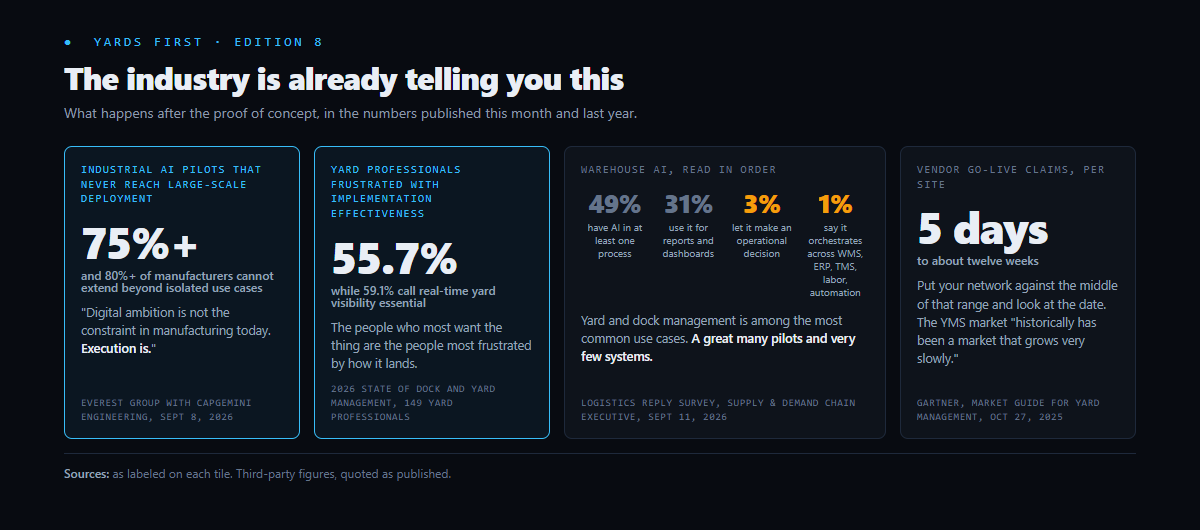
Yards are not a special case here. Everest Group, working with Capgemini Engineering, reported on September 8 that more than 75% of industrial AI pilot projects never reach large-scale deployment, and that over 80% of manufacturers cannot extend AI beyond isolated use cases. The obstacles they list are rigid processes, legacy technology, fragmented data, and a shortage of cross-functional skills. Not one of them is "the software was not smart enough." Nicolas Rousseau of Capgemini Engineering put it in one line: "digital ambition is not the constraint in manufacturing today. Execution is."
Now come down to the dock. Supply & Demand Chain Executive published a Logistics Reply survey on September 11, and yard and dock management is among the most common places warehouse AI gets used. Read the rest of it in order. Forty-nine percent of respondents have AI in at least one process. Thirty-one percent use it to generate reports and dashboards. Three percent let it make an operational decision on its own. One percent say it orchestrates work across the WMS, ERP, TMS, labor, and automation together. That is a great many pilots and very few systems.
The yard survey says the same thing from the buyer's chair. C3 Solutions' 2026 State of Dock and Yard Management, 149 yard professionals, found that 59.1% call real-time yard visibility essential and 55.7% are frustrated with system implementation effectiveness. The people who most want the thing are the people most frustrated by how it lands.
Gartner's Market Guide for Yard Management (October 27, 2025) says the quiet part out loud: the YMS market "is much smaller compared to the WMS and TMS markets, and historically has been a market that grows very slowly, although this is changing." Twenty years of software, and most yards still run on tribal knowledge, a two-way radio, and a clipboard. That is not because nobody built anything. It is because what got built stayed where it was built.
Why it stays
Here is the pattern, and if you run more than a handful of yards you have lived it.
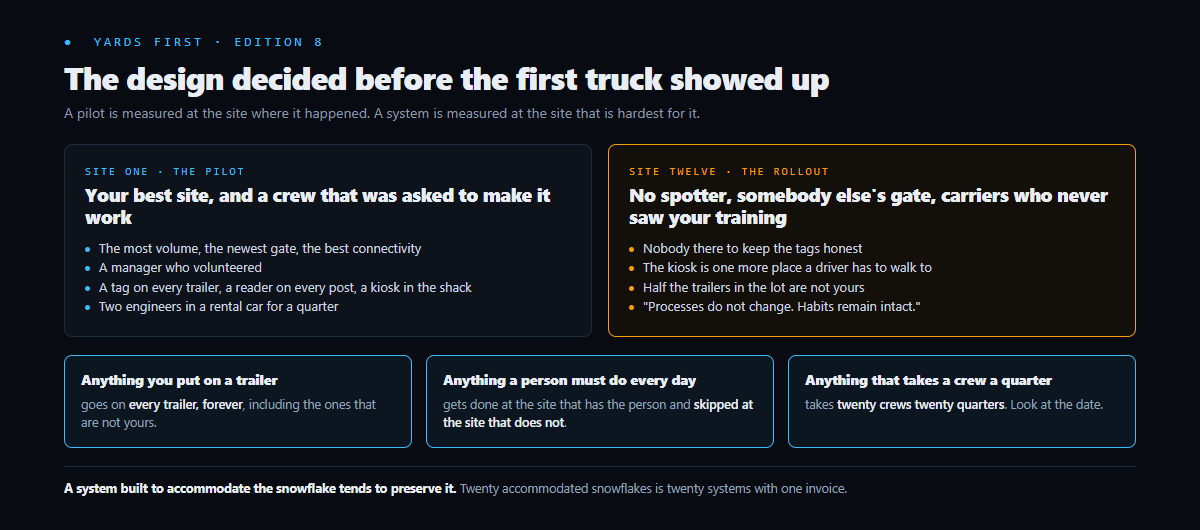
The vendor picks your best site, or you pick it for them. It has the most volume, the newest gate, the best connectivity, and a manager who volunteered. In goes a tag on every trailer, a reader on every post, a kiosk in the guard shack, and two engineers in a rental car for a quarter. The crew keeps every tag honest because they were asked to. At the end of ninety days the numbers are real, everybody signs the case study, and the rollout goes on the roadmap.
Then the rollout meets site twelve. Site twelve has no spotter. The gate is staffed by somebody else's employees. Half the trailers in the lot belong to carriers who will never sit through your training. Nobody is there to keep the tags honest, and the kiosk is one more place a driver has to walk to when all he wants is to get in, drop the load, and keep rolling. Matt Yearling of YMX Logistics said it plainly to The New Warehouse in January: "Processes do not change. Habits remain intact."
Whether a site turns twenty trailers a day or two hundred, the design decided the outcome before the first truck showed up. Anything you have to put on every trailer, you have to put on every trailer...forever, including the ones that are not yours. Anything a person has to do every day for the data to be right will get done at the site that has the person and skipped at the site that does not. Anything that takes a crew a quarter to install takes twenty crews twenty quarters. Gartner's guide collects vendor go-live claims that run from five days to about twelve weeks per site; put your network against the middle of that range and look at the date.
Bart De Muynck wrote on the YMX Logistics blog in December that "every yard operates like a unique snowflake," and recommended consistent gate protocols, trailer numbering, and data formats across all facilities. He is right about the disease and right about the cure. I would only add that a system built to accommodate the snowflake tends to preserve it. Twenty accommodated snowflakes is twenty systems with one invoice.
What "built for scale" actually means
Every vendor slide says scalable, ours included, and I have no interest in writing the yard version of "we are really good at sending cold emails, have you tried our marketing automation software." So here is what I mean by it, in terms you can check. Scale is not a phase of the project and it is not a line on a price sheet. It is a set of design decisions made before the first install, and every one of them shows up as something the system does not need.
Nothing on the trailer: Trailer location comes from a camera in the spotter cab, not a tag on the trailer and a reader on every post. The gate reads from a camera over a lane you already have. The honest limit: a camera in the spotter cab sees what the spotter touches, so a trailer parked in a back corner for a week is a gap until somebody drives past it. I would rather say that here than have you find it.
Nothing on the driver: A driver checks in from his own phone, with no app to download and no shack to walk to. Carriers onboard by showing up. More than 200,000 drivers have checked in through the system, over a million check-ins, and not one of them installed anything nor received any formal training. A system that scales cannot depend on the one person in the operation who does not work for you.
Nothing on paper: The dock signs the bill of lading (BOL) on a screen, timestamped, and the record follows the load. Retire the clipboards, and the "where is the paperwork" phone call retires with them.
Nothing to reinstall: The base system, driver check-in plus the digital BOL, goes in under thirty minutes with minimal training. Cameras take people, and when they do, it looked like cameras onto twelve spotters across a five-facility campus in two days, and a gate camera install that went live overnight. Some pre-planning is required, but that's on the vendor. Every yard runs the same check-in, the same BOL, and the same map, so when something gets fixed at one yard it is fixed at all of them the same day.
Nothing left out: It was designed from a yard with no spotters to a campus running ten or more, and built to pay for itself at the low-volume yards, not only the top quartile. The network result lives in the yards nobody puts in a case study.
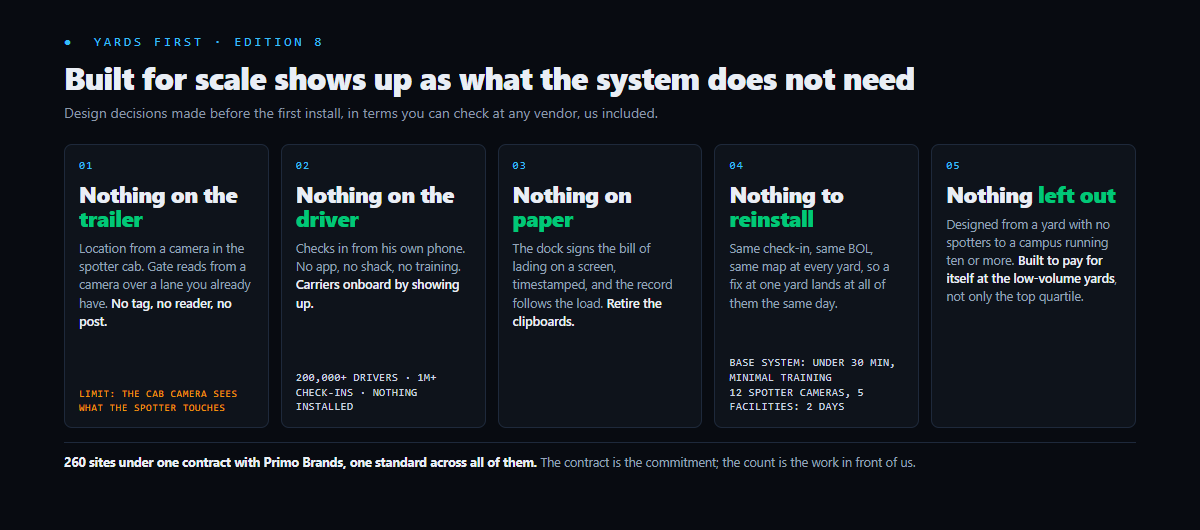
That is the whole difference between a pilot and a system. A pilot is measured at the site where it happened. A system is measured at the site that is hardest for it.
The number that matters
The measured result at one site is gate to gate in 24 minutes instead of 48, and about 5% more volume on flat headcount, observed. Modeled conservatively, that is more than a million dollars a year per site in profit from recovered production capacity. Read it the way a plant manager reads it: the plant did not run out of machines, it ran out of trailers at the door, and the cap lifted.
That same design is what we are implementing with Primo Brands across 260 sites under one contract, one standard across all of them. The contract is the commitment; the count is the work in front of us. I would rather be judged on the result at the hardest of those sites than on a logo count, and I expect you feel the same way about your vendors.
What to ask instead
If you are evaluating yard technology this year, the reference call at the vendor's best site tells you what happened at a site that is not yours. Ask three things in writing before that call: what goes on each trailer, who has to be on site every day for the data to be right, and what site twenty gets. If the answers are a tag, a guard, and the same project again, you are buying a very good pilot.
Simon Tunstall of Gartner told Logistics Management, "You don't have to buy the whole thing on day one," and he is right. Start at one yard. Make sure it is the hard one. And make sure whoever you're working with knows how to get beyond that first site.
The next decade of capacity in this industry is sitting in yards, and it is only reachable if the automation travels. We put a new front page up at yardflow.ai this week that says what we built and how fast it goes in. Go look at it, then reply and tell me the one site in your network you would least want a vendor to see. That is the site I want to talk about.
Jake Koppinger Co-Founder and CEO, YardFlow by FreightRoll
Reply on LinkedIn, where the comments are (opens in a new tab)