Your bank will not send two hundred dollars to somebody you have never paid before without a code to your phone. Your email will not open on a new laptop without one.
Then a loaded trailer rolls out of a distribution center and the entire check is a person at a window deciding whether the line behind it is too long to stop it.
It is Labor Day. Verisk CargoNet published its holiday cargo theft advisory on Friday, and it is worth ten minutes of a day off, because the interesting part is not the headline.
The theft is not on the holiday. It is on the days around it.
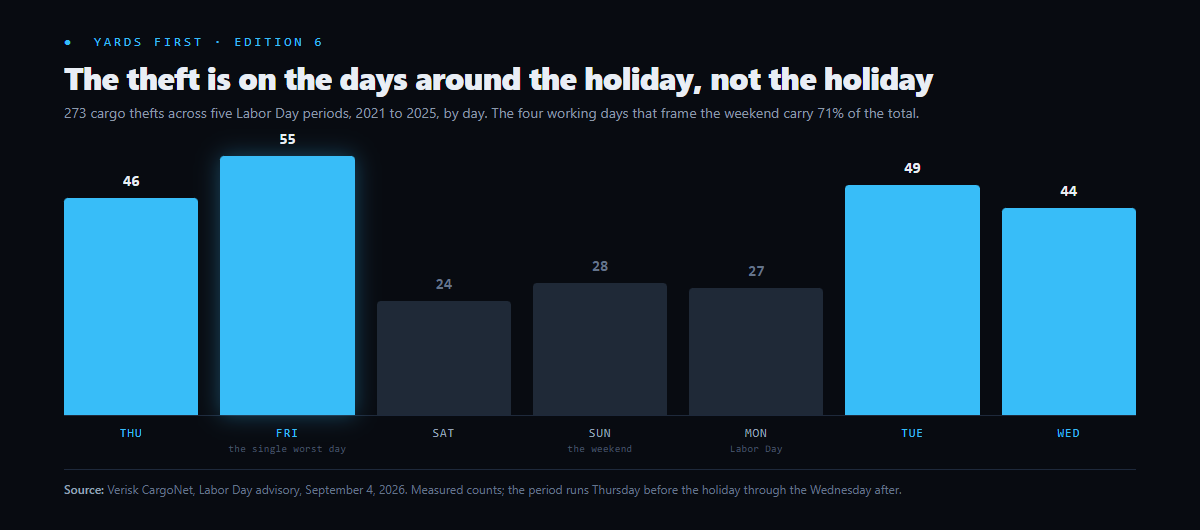
CargoNet counted 273 cargo thefts across the five Labor Day periods from 2021 through 2025, Thursday before through Wednesday after. The annual count rose 70% over those five years, from 33 to 56, with 70 in 2024 the high. About $31.8 million in all, roughly $116,000 per event.
Now read the calendar inside that number, because that is the part most people skip. The single most active day in the entire five-year set is the Friday before the holiday, with 55 incidents. Friday, Tuesday, Thursday, and Wednesday together account for 71% of the total. The holiday weekend itself, the part everybody pictures when they picture a facility standing empty, is comparatively quiet in the data.
That should bother you more than the total does.
Thieves are not turning up when your sites are dark. They are turning up when your sites are moving, when the appointment book is full, when everyone is pushing to clear the yards before a long weekend and the person at the gate has eleven trucks stacked up behind the one in front of them. They come for the busy. Food and beverage is the top target, 49 of the 273.
CargoNet's own description of the target, from its 2024 advisory, is the loaded trailer "left unattended as workers begin their holiday weekend." Put the two together and you have the whole picture: the load gets staged on the busiest afternoon of the year, and the check that should have decided whether it left went whichever way the line went. CargoNet's most common sites for it are warehouses, truck stops, and large retail parking lots rather than truck yards, and a load released from your dock to the wrong tractor becomes somebody else's parking lot statistic.
Every executive I meet believes they run a tight site
I cannot prove this one with a study, so I will state it as what it is. I have a strong suspicion that sites which are genuinely locked down, meaning cameras and people and tight process, lose meaningfully less freight than sites with leaky process. Most executives believe they run the first kind. The reality on the ground is closer to the second.
Here is what that gap looks like. At one distribution center I know well, there is a box at the exit for trailer tags. A driver on the way out is supposed to drop the tag in the box, and because the tag was already slated for exit, the box is a genuinely decent second factor. Small physical proof that this trailer was meant to go today.
And when there is a backup, the box plays second fiddle to the backup.
Nobody decided that. No executive ever wrote a policy that said wave them through once it gets busy. It happens because the protocol depends on the work effort of individuals on site and on tribal knowledge that lives inside whoever is on shift, and because a human being looking at a line of idling trucks will always weigh the delay they can see against the theft they cannot.
A control that yields to a line is not a control. It is a preference.
The last edition made a version of this point about counting: a tag-based trailer count mostly measures whether people put tags on trailers. Same failure, moved to the exit, where it costs a great deal more.
To be clear, as long as humans run the yard, these sorts of workarounds are inevitable. However, with system-driven protocols, controls and efficiency, such workarounds can be minimized.
Not all cameras are created equal
Traditionally, a camera at a gate does one job. It records trucks coming in and trucks going out so that somebody can examine the footage later. That is a witness. Useful after a loss. Inert during one.
There is a second job, which is live. A person watches the feed and opens a gate for a truck they recognize. That works, and it costs a full-time employee at a screen for every hour the gate is open.
Neither of those is authentication. If you wanted to use that camera as an actual check, the person watching would have to thumb through two or three different screens to work out whether this tractor and this trailer should be let out at all. And a vast majority of the time, that data is not sitting on any of those screens. So the camera goes back to being a picture of what is going on.
The problem is what the camera is attached to.
Passive authentication
Multi-factor authentication at a facility is almost always a manual protocol. A person checks a paper, a person eyeballs a tag, a person decides. It works exactly as well as the day's pressure allows.
A camera paired with an underlying system adds a factor that does not depend on anybody's work effort at the moment the line is longest. Call it passive authentication. Here is the shape of it.
The check-in. A driver arrives and checks in from their own phone. No app, no kiosk, no clipboard. Behind the check-in sits a pickup or appointment reference: a name, a carrier, a callable number.
The signature. The dock signs the bill of lading (BOL) on a screen, timestamped. The BOL is a contract, a receipt, and a document of title all at once, which is why that timestamp carries weight.
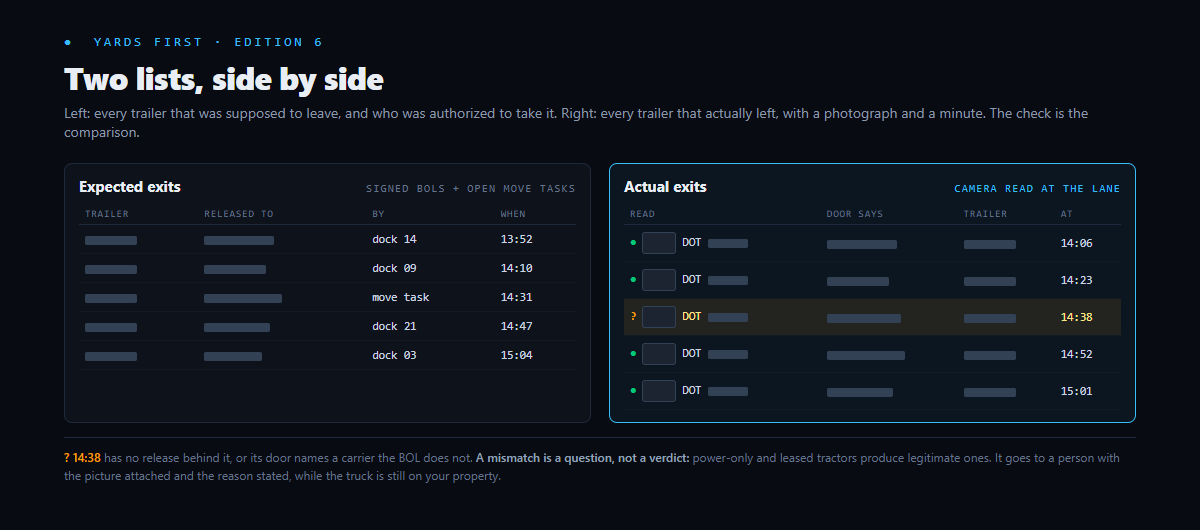
The expected list. Signed BOLs plus open move tasks are the list of trailers expected to leave your sites and who is permitted to take each one. That list already exists inside the day's work. Nobody has to build it.
The actual exit. At the exit lane, a camera reads the tractor on its way out: the DOT number and the carrier off the door, the unit number, the make, the color, and the trailer behind it, with a photograph and a timestamp. One exit pass in a spring test produced exactly that record. In the same test, one tractor was recorded nine times in thirteen hours, and nobody had to write anything down.
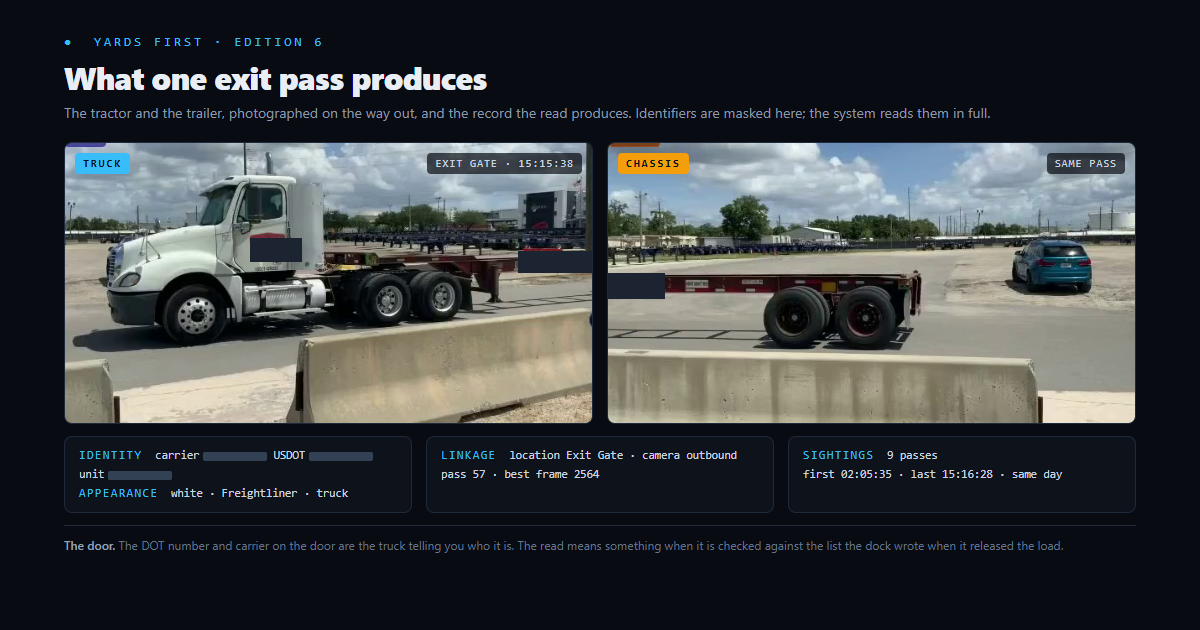
So you have a list of potential exits, and then you have the actual exit itself. The read on its own is one more witness; a door can say anything. The factor is the comparison. When those two do not match, you have the opportunity to catch cargo theft, in the seconds while the truck is still on your property rather than in a footage review three weeks later.
A mismatch is a question, not a verdict. Power-only moves and leased tractors produce perfectly legitimate mismatches all day long, and a system that treats every mismatch as a thief will train your people to ignore it inside a week. The right output goes to a human with the picture attached and the reason stated: this trailer has no release behind it, or this door names a carrier the BOL does not. The system trains itself to provide fewer mismatches over time.
Note who is not inconvenienced. The honest driver is never asked for one more thing. They checked in from their own phone. They got signed at the dock. They drive to the lane, keep rolling, and drop the load where it was going. The check happens to the record, not to the driver.
What the camera learns
CargoNet's second-quarter report is why this matters more this year than last. Q2 2026 recorded 677 incidents, down 26% year over year, with theft events falling from 488 to 378. Estimated losses went the other direction, $304.6 million against $135.7 million, which CargoNet described as heavily influenced by extreme losses. Fictitious pickups barely moved at all, 165 in Q2 2025 against 158 in Q2 2026. Volume fell by a quarter. Targeted fraud held flat.
Keith Lewis, CargoNet's vice president of operations, put it better than I can: "Lower incident volume should not be mistaken for lower risk. The groups driving the largest losses are not necessarily trying to steal more freight; they are trying to identify the right shipment."
That tells you what the adversary is doing: selecting one shipment, with the paperwork in order. The comparison I described catches the trailer nobody released and the trailer released to one carrier and taken by another. A pickup that was fraudulent at booking arrives with a signed BOL and a carrier the dock expected, and it clears the lane. That is the case the camera has to learn.
The other thing about cameras sitting on a real data layer: they get better with time. Over enough passes, the system can tell when something about the physical asset looks off. A tractor that does not match what is known about that carrier's equipment. An asset that arrives against a shipment expectation it does not fit. A carrier whose behavior in the record does not match the authority it is operating under, which is the whole game with a ghost carrier. Pair that with a database of driver execution and driver identity and you triangulate instead of guess. It is a check that runs on every exit, including the boring ones, including the four hundredth truck on the Friday before a holiday. People are not built for that. Systems are.
The carriers' and the insurers' fictitious-pickup checklists are directionally right about this. Photograph the trailer, the tractor, the plates, the DOT placards, the driver ID, the BOL, and the seal at pickup. Verify driver identity. Cross-check DOT numbers. Keep all of it. Good list. It is also a manual protocol assigned to the busiest moment of somebody's worst day. The question was never whether the list is correct. It is whether the list survives a backup at four in the afternoon on the Friday before Labor Day.
Where this argument stops working
Three places, and I would rather name them than have you find them.
If nobody can act, an alert is just a better recording. Real-time risk alerting is only worth something if a person or a gate can act inside the window the truck is at the lane. An alert that lands in an inbox somebody opens on Wednesday is a nicer archive.
A guard who hand-validates every BOL beats all of it, and you pay for it. Ten minutes per truck, cross-checking documents by hand, is more secure than anything I have described. It is also a line that reaches the public road by mid-afternoon. Certainty and time trade against each other. Many jobs like this are facing pressure to move more quickly for obvious reasons, resulting in mistakes. Move the check into the system and you stop making that trade at the gate.
If you run two exits and twenty trucks a day and one person who knows every driver by name, tribal knowledge genuinely works. It works right up until that person takes a vacation, or you open a third site, or the volume doubles. Tribal knowledge does not scale and does not transfer. It leaves when the person leaves.
One thing to do tomorrow
Tomorrow is Tuesday, which sits inside the four days that carry 71% of Labor Day cargo theft. This is a live exercise, not a thought experiment.
Ask your sites for two lists covering last Friday. The first: every trailer that was supposed to leave, and who was authorized to take each one. The second: every trailer that actually left, with a timestamp and an image of the tractor that pulled it.
Then put them side by side.
If your team can produce both lists inside an hour, you are in better shape than most, and your next stop is the exceptions. If they can produce the second one and not the first, you have a witness and no check. If they can produce neither, that is not a gap in your reporting. That is your security posture, written down for the first time.
None of this requires a construction project. A gate camera install went live overnight. The expensive part was never the hardware. It was having something for the camera to compare against.
Reply to this edition and tell me which of the two lists your sites could actually produce. I read every one, and the answers are usually more interesting than the advisories.
Jake Koppinger Co-Founder and CEO, YardFlow by FreightRoll
Reply on LinkedIn, where the comments are (opens in a new tab)