A hockey puck is a wonderfully honest piece of engineering. Six ounces of vulcanized rubber, frozen before the game so it will not bounce, built to do exactly one thing: stay where somebody puts it. A puck has no opinion. It has never once decided to be somewhere else.
There are (different kinds of) pucks in a lot of yards right now, and they are being asked to do a much harder job than the one in the rink.
In the RFID approach to seeing what is in your yards, a magnetic puck is the sensor. A driver arrives, retrieves a puck, attaches it to the trailer, and drops it where it belongs. Staff keeps track of the inventory of pucks. Pucks get lost, they get damaged, they get driven off the property still stuck to a trailer, and somebody buys more of them. The puck collection bucket often needs an explanation, leaving truck drivers confused and pushing the exact "help" button that the pucks were designed to avoid. The reader is line of sight, so to collect the reads at all, somebody has to drive around the yards.
Notice what this actually describes. The technology is not the sensor. The driver is the sensor.
Here is an alternative, bolted on a spotter in one of our customers' yards. It is looking out of the window. Nobody has to hand it anything.

What happens when a person is the sensor
I want to give you two specific afternoons from one of our sites, because this is the kind of claim that should come with timestamps or not be made at all.
The first one. Our cameras had four trailers on the map at 4:11 in the afternoon, in spots 82, 83, 87 and 88, each one with a photograph and a spot number attached to it. The incumbent RFID system's next hourly report, at five o'clock, said all four of those spots were empty. It did not show them filled until 6:01 PM, one hour and fifty minutes after we already had them. The trailers had not moved. They had been sitting in those four spots the whole time, and every one of them was flagged in the incumbent's own records as having no location at all.
The second one is worse, and it is a different kind of error. Trailer 17038 was read by our camera at 4:10:30 PM, in spot 42. The incumbent returned no match for that trailer at four o'clock, and no match again at five o'clock, fifty minutes after our read. It surfaced at 6:01 PM, in spot 42, exactly where our camera had put it almost two hours earlier.
That second one is not a location error. The system did not have the trailer in the wrong place. The system did not know the trailer was on the property. All of this with photo evidence for verification.
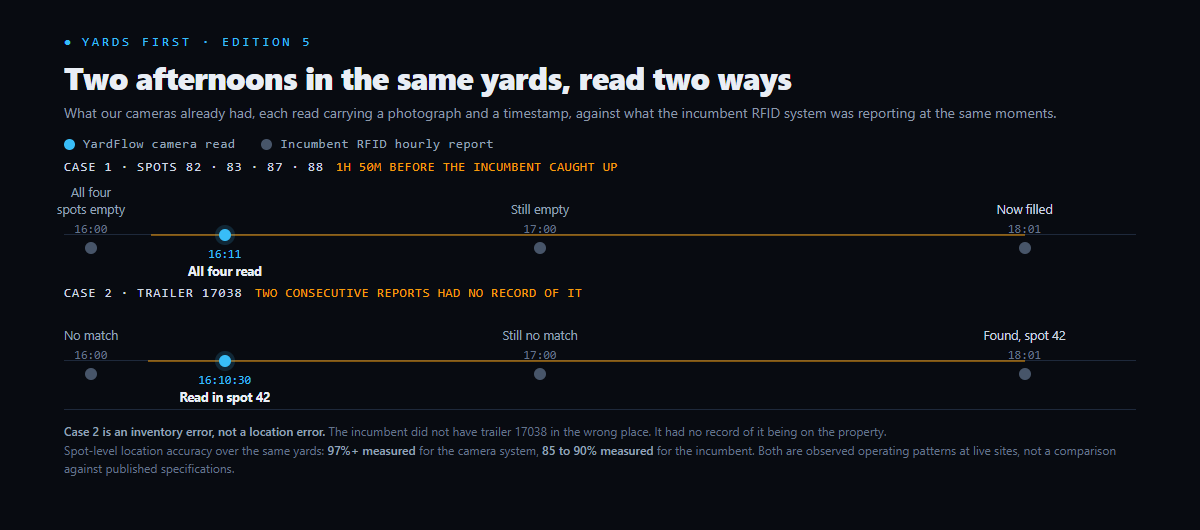
Across the site, this is the difference between about 97%+ spot-level accuracy, measured, and about 85 to 90%, measured. I want to be careful with those two figures, because I have seen too many vendors be careless with numbers like them. Both are our own observations of how the two systems performed in live yards. Neither is a comparison against anybody's published specifications, and I am not going to present them as one.
The number is not measuring what you think it is measuring
Here is the part that changed how I talk about this.
That measured 85 to 90% is not really a measurement of a technology at all. Nothing about radio frequency identification is unreliable at that rate. RFID reads a tag it can see, reliably, all day. The gap is not in the physics.
The gap is in everything the system needs a person to do first. A puck has to be on hand. Somebody has to attach it, to the right trailer, and drop it in the right place. Somebody has to notice one has gone missing and replace it. Somebody has to drive the reader past it. Every one of those is a step where a human being who has fourteen other things to do can reasonably fail, and every failure lands in the report as though it were a fact about the yards.
So the accuracy figure for a puck-based system is not an accuracy figure. It is a compliance rate wearing a lab coat.
And a compliance rate has a property that a measurement does not: it decays under exactly the conditions where you need it most. On the calm Tuesday it is fine. On the afternoon when everything is late, the yards are full, and nobody has a spare minute, the pucks are the first thing to go, and that is the afternoon you needed to know where trailer 17038 was.
For the driver, none of this was ever the job. They came to move a trailer. Every step we bolt on between the gate and the exit is one more thing a stranger in a hurry has to be talked into caring about, and we are the ones who decided it should matter to them.
The honest version of our side
Now the other side of the coin, because I would rather say this myself than have you say it to me.
We did not replace hardware with software. We replaced hardware with different hardware. Our team was on site this month at a customer campus in Pennsylvania, putting cameras on spotter trucks and at the gates. Twenty four devices. That is a real install, with a real mechanic, real wiring harnesses, and a real day of somebody's life.
It did not go to plan either. We had meant to run it in two phases, harnesses one day and devices the next, the phases collapsed into each other, and a portion of the devices came up offline. Everything is installed. What is left is rewiring and testing, and we can do most of that remotely. Next time we do every device on a spotter in a single day, and every piece of hardware is provisioned before anyone gets on a plane.
This is what that actually looks like.
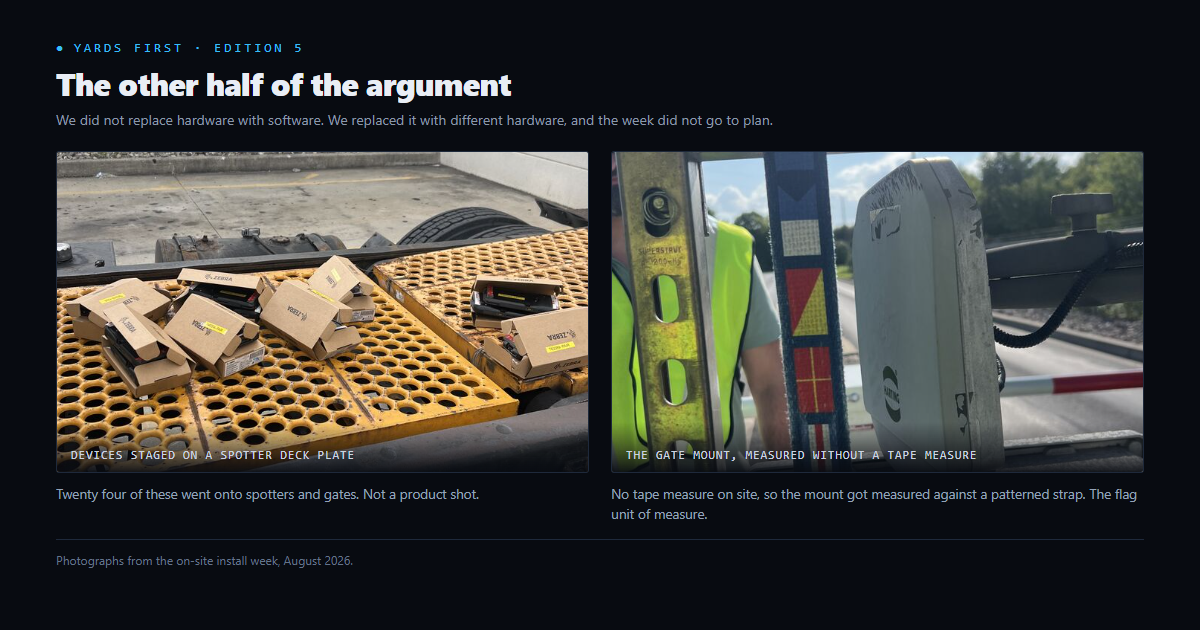
Chris, my co-founder, told the version of that week I like better than mine. The crew got to the gate without a tape measure, so Casey measured the mount against a patterned strap somebody had in a bag and christened it the flag unit of measure. The gate cameras were installed and operational by the next morning.
So I am not selling you a world without hardware. Both approaches put equipment in your yards.
The difference is who carries it afterward, and how often:
The puck model: a person has to do something correctly on every trailer, on every movement, on every shift, forever. The count is worth exactly what that compliance is worth.
The camera model: a crew does something difficult once per vehicle, for one hard day. After that, nobody in your yards is asked for anything, and the count does not care whether it is a calm Tuesday or the worst afternoon of the quarter.
One of those burdens ends. The other one is the operating model.
There is a tell for this which I heard it from the horse's mouth. A customer had five facilities under contract for the puck system. Only one of them was using it. They were paying for all five, and four of them had quietly stopped doing the steps, because the steps cost more than the report was worth. Nobody cancelled anything. It went unused but paid.
Where this argument stops working
If your yards are small enough that one person can walk the whole thing in ten minutes and know what is there, you do not need cameras and you do not need pucks. You need a clipboard, and I will be the first person in this industry to tell you to keep it.
And if you genuinely control your carrier base, if every driver through your gates is your employee or on a contract you can enforce, then puck compliance is a management problem you can actually solve, and RFID becomes a reasonable answer. That is a real operating condition and some of you have it.
Most do not. Most of you have a mixed carrier base, drivers you will see once, and no ability to make a stranger in a hurry care about your inventory system. If that is your situation, any approach that needs their cooperation is going to give you a number you cannot trust on the days you need it.
One thing to do this week
Do not take my word for the gap. Measure your own.
Pull up the inventory report for your yards right now, on a screen, and write down what it says. Then walk your yards and count. Not a sample, the whole thing, once.
The difference between those two numbers is what I have been describing for the last thousand words, and it is already in your operation whether or not anyone has ever written it down. If they match, you have a good system and I would genuinely like to hear what it is. If they do not, you now know the size of it, and you can stop making decisions against a number that was never a measurement.
Cameras do not need a favor from anybody. That is the entire argument.
Jake Koppinger Co-Founder and CEO, YardFlow by FreightRoll
Reply on LinkedIn, where the comments are (opens in a new tab)