Prepared for Crowley · 26 terminals audited · one network standard
The Yard Network System, by FreightRoll.
Your yards are the gap in your supply-chain stack. YardFlow fills it.
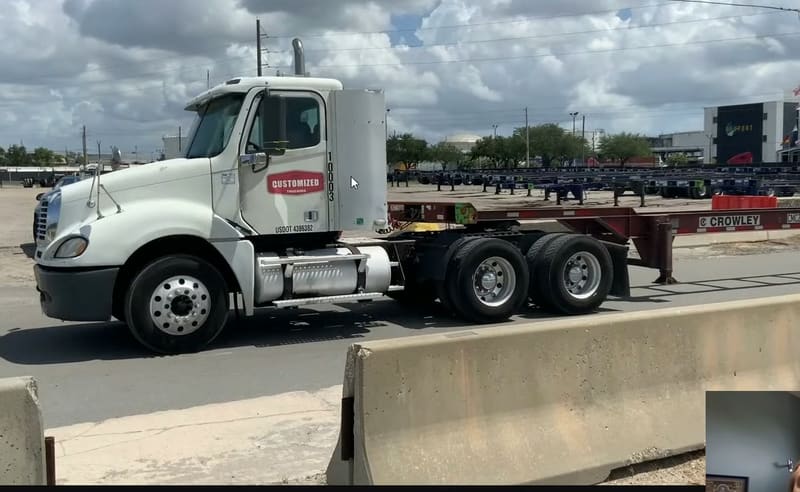
You move the freight. A Jones Act fleet runs the Puerto Rico, Caribbean, and Central America trades, and the new LNG ships and terminals are years ahead. The one place that flow still goes dark is the yard. A box comes off the ship, a chassis waits in the stacks, and a drayage truck hunts for both while the detention clock runs.
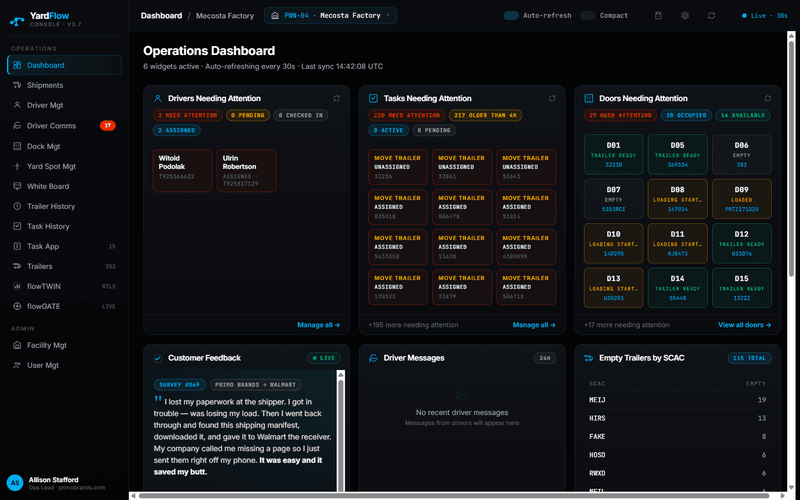
YardFlow is the Yard Network System, the software layer between your TMS and your WMS. It makes every container and chassis legible at every terminal, so the truck moves before the clock does. At Primo, drop-and-hook turns fell from 48 minutes to 24, on flat headcount.
- 48 to 24 min
- drop-and-hook turn, measured at Primo
- 26
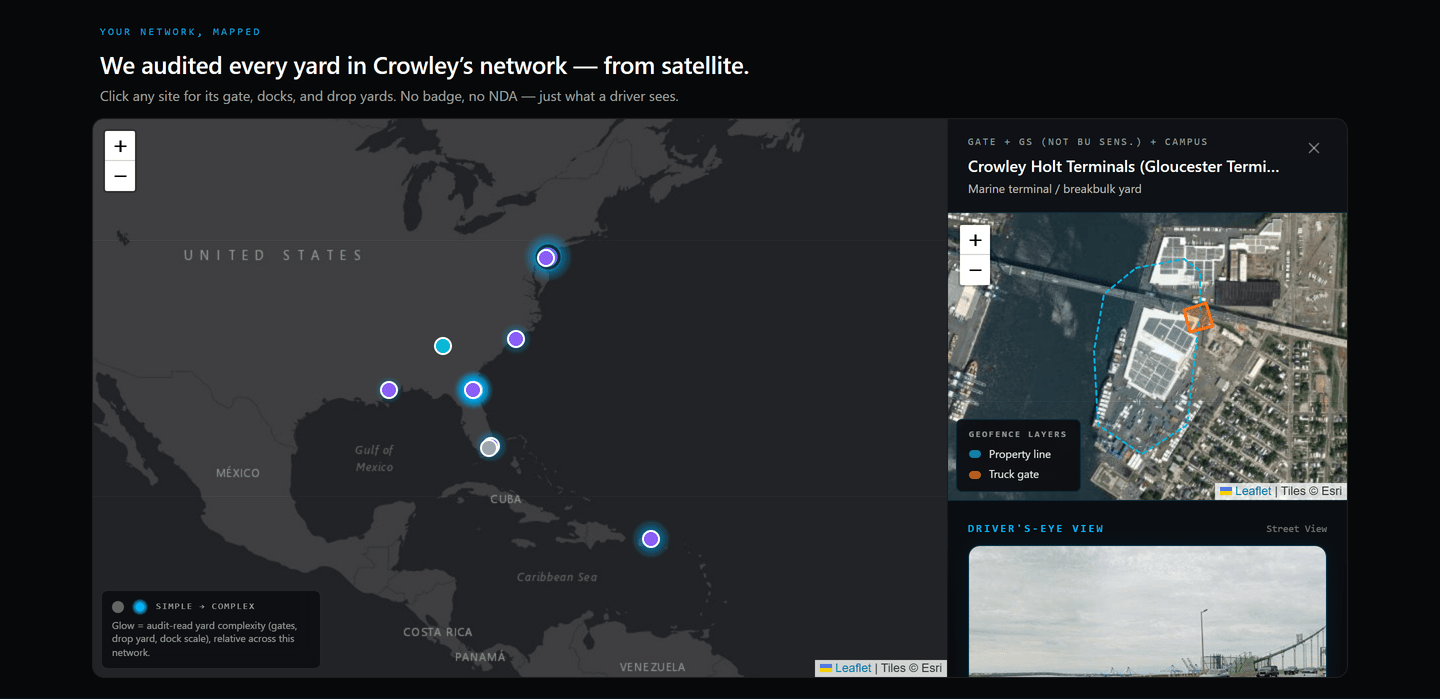
- Crowley terminals audited from satellite
- 3,067
- trailer and chassis spots across the network
- The gapYour TMS runs the ocean and the road, nothing runs the terminal yards the boxes land in.
- What it doesEZ-Pass at the gate, air-traffic control for containers and chassis. No paper, no radios.
- The proofPrimo: turns cut 48 to 24 min on flat headcount, 100% of the network committed, the first ever.
- The payoffFaster turns, less detention, fewer escapes. Become the shipper drayage carriers pick first.
Already live at scale · the Primo Brands network
The Yard Network System runs the yards behind these household brands. Live today, rolling to 100% of the network.

The problem
The box, the chassis, and the truck all wait on the same yard, run by radio.
At the Talleyrand terminal in Jacksonville, 197 acres of container stacks and chassis rows feed off a gate sequenced by radio and clipboard.
A drayage driver who cannot find the box walks into the office to ask. The next truck idles at the gate, and our read is that the detention clock is running. The crane on the pier never sees it.
Why now
The freight cycle is turning. The yards that waste a driver's day will lose the carriers.
Every terminal you run is a promise to a customer and to the drayage carriers that haul the boxes inland.
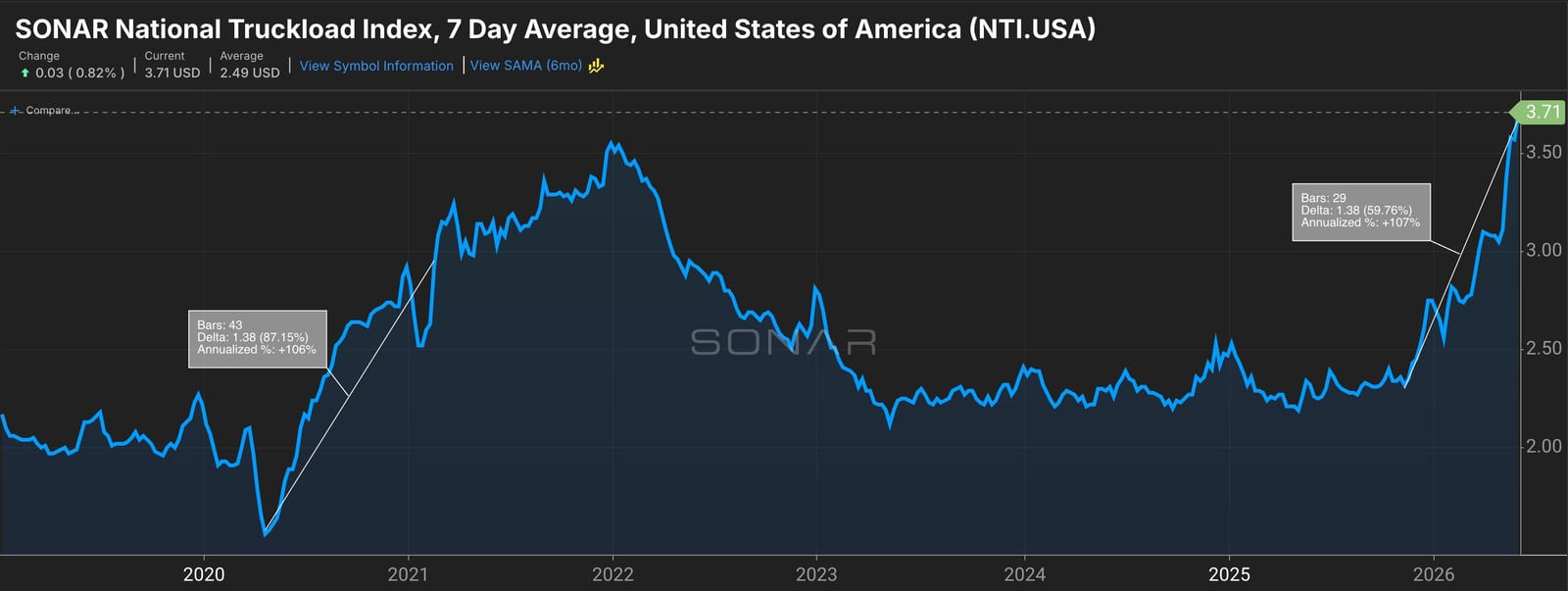
You keep both on how fast a truck gets through your gate. For the first time in four years, pricing power is swinging to carriers as capacity tightens. The next spot market punishes operators whose yards burn a driver's afternoon. Detention starts at hour two and runs $50 to $100 an hour, and drivers now pick their lanes. Every printed gate slip, every forced check-in, every chassis a driver hunts down is added cost on a thin contract. When trucks cost this much, that cost counts double. Standardize the gate and you turn more trucks through the same lanes, on the same headcount. A network standard is a service no rival can match terminal by terminal.
The Yard Network System
One standard between your TMS and your WMS, on every yard Crowley runs.
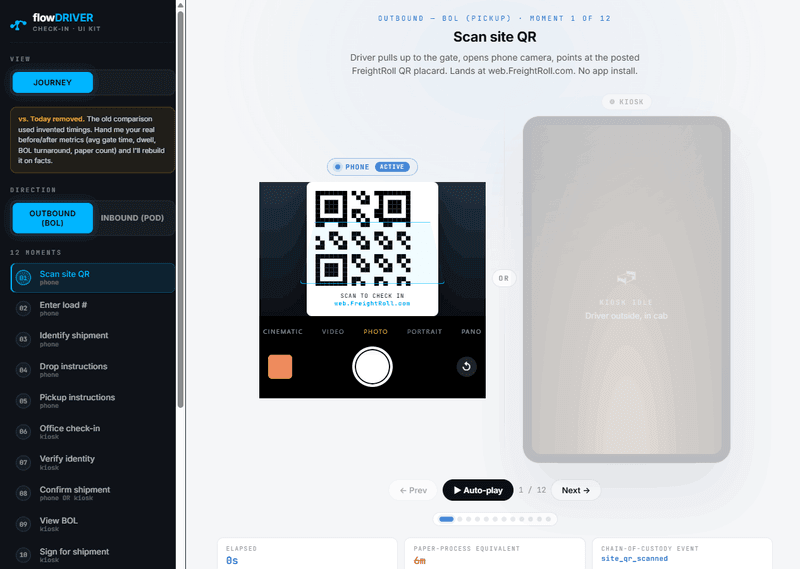
Every yard runs the same jobs, and the same people run them. The Yard Network System gives each of them one standard across every site. The driver checks in from their phone with flowDRIVER. The spotter moves the trailer while computer vision in the cab maps the yard with flowVISION. The dock coordinator assigns the door from flowYMS. The dock office signs the BOL with flowBOL. The executive watches every yard on flowNETWORK. Under all of it, machine vision reads the truck at the gate and an agent dispatches the next move. Think EZ-Pass at the gate and air-traffic control for your trailers.
The proof · already at scale
No company had ever put its whole yard network on one system. Primo just did. Crowley would be the first shipping and logistics network to take it.
The point is not faster trucks. It is realized production capacity: 5% more volume out the door on the same headcount, capacity those plants could not ship before.
Primo started with one layer: the driver journey. Text the truck instead of checking it in. Paper out of the gate. No more driver-to-dock-office handoff. Across the sites where it went live, those yards shipped about 5% more volume than the sites without it, on the same dock-office headcount. That alone is why Primo committed all ~260 sites to the full Yard Network System, the first national shipper to standardize every yard on one protocol. The YMS is rolling now. Live at 10 plants, every production site by the end of Q3. The 5% came from the lightest touch. The rest is still ahead. Crowley would be the first shipping and logistics network to standardize its terminal yards on one protocol.
“Your software enabled us to take on additional volume while remaining headcount neutral in the dock office. That was an integral part of our strategy, and it has been proven.”
Result measured on the driver-journey layer, before the YMS rollout. Primo is live at 10 plants today, every production site by the end of Q3.
What it touches
A new layer, not a new migration.
YardFlow runs in the yard and talks to the systems you already have. Your TMS and WMS stay the systems of record. Nobody is ripping anything out.
Built for enterprise infosec review. We connect over your standard API or EDI and scope to yard operations, not your ERP of record. Full integration and security review happen in the audit.
- In the yardflowDRIVER (driver app, no install) and flowGATE (camera gate) run on YardFlow. Your spotters and gates keep working.
- Keep your YMSRun alongside any local terminal system you have. Switch only if and when you decide to.
- ReadsYour TMS appointments, over standard API or EDI.
- WritesGate and turn events back to your WMS, so dock and inventory stay current.
- IT lift
Your own audit
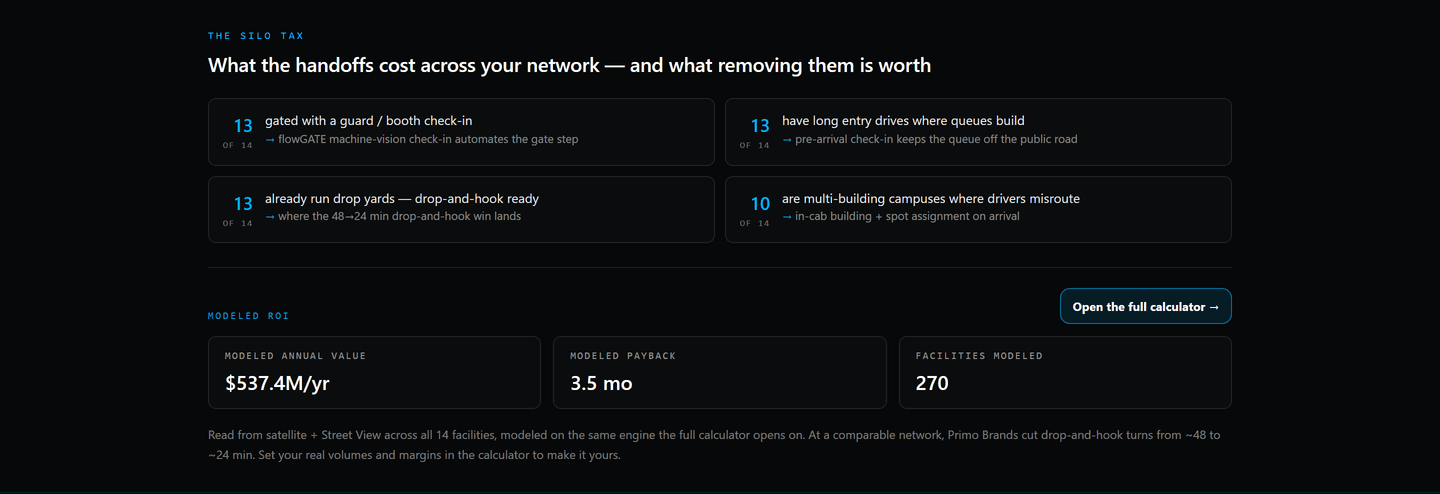
This is Crowley's own audit, not a generic benchmark. We mapped 26 terminals from satellite. Here is what the manual handoffs cost today, and where the standard lands first.
- 22 of 26
- Truck-gatedflowGATE automates the check-in and exit the booth does by hand
- 16 of 26
- Staffed by a guard or booththe manual gate step the network standard removes
- 11 of 26
- Fast-lane opportunityroom for an EZ-Pass lane that keeps the queue off the road
 See all 26 sitesOpen the audit →
In short
Start at Talleyrand. Prove it in sixty days. Then build the network.
The pilot is one move: a camera at the gate that reads who took which chassis, when, and whether it came back. Twenty-five thousand dollars, sixty days, cameras at our cost, and it credits to Year 1 if you scale. The agreement is ready to read and sign now, the full statement of work in one place. If the data does not change how you run the yards, you are not locked into anything. Then the same system rolls to Port Everglades, Isla Grande, and the rest of the network.
Pick a time and you are on the calendar.
Thirty minutes, direct with Casey Larkin. Pick an open time below and you are booked.
None of these times work? Email me at casey@yardflow.ai or call or text me at 410-236-7434, and we’ll find one.
Casey Larkin, YardFlow. Jake Koppinger, our founder, joins when it helps.