Every January the gyms fill up. By March the treadmills are free again. Signing up was never the hard part. Showing up on the hundredth morning is.
Technology for the yards splits along the same line, and most teams evaluate only the first half.
There are four common places to start fixing your yards: a real-time location system (RTLS) that tracks trailers, machine vision at the gate, a digital driver journey, and a yard management system (YMS). Rank them by how easy they are to pilot and you get one list. Rank them by how easy they are to roll out across a network and the list flips.
The inversion nobody prices in
Easiest to pilot, in order: RTLS, gate vision, driver journey, YMS. Put up a few cameras, read trucks and trailers as they move, and nobody on your team changes a thing. That is why vision pilots are so easy to say yes to. No new habits, no retraining, no "change management."
Easiest to industrialize, in order: driver journey, YMS, then the hardware, gate vision and RTLS. The software your people and your drivers touch deploys remotely in 30 to 60 minutes per site once the playbook exists. The cameras need crews at every site: mounting positions, blind spots, connectivity, sometimes civil work.
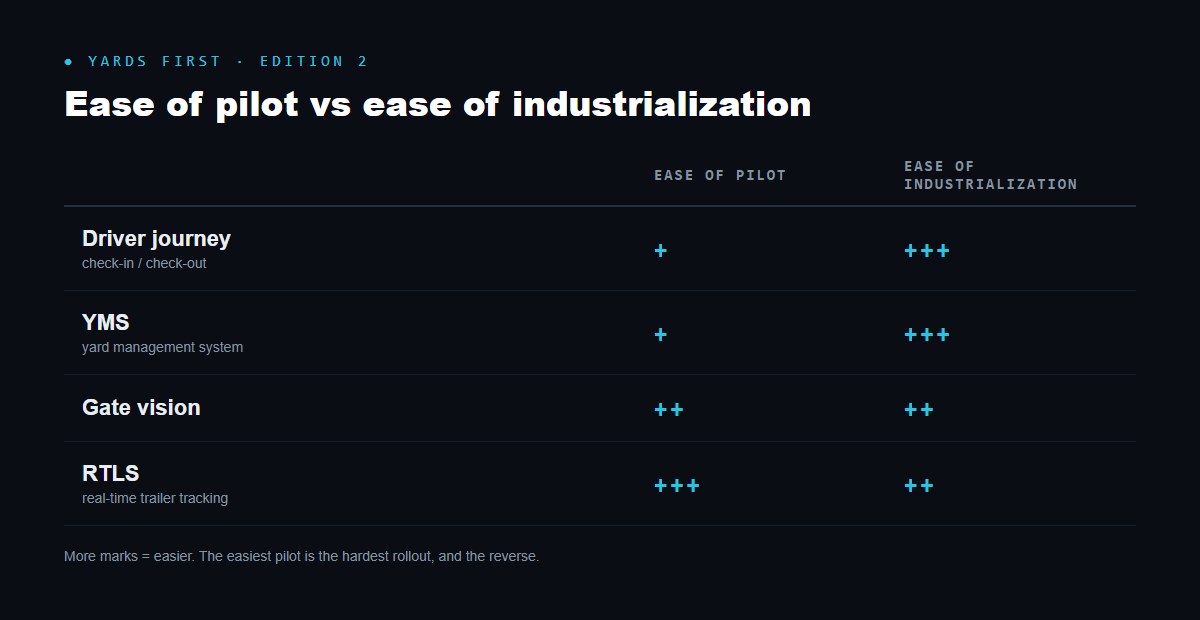
So the easiest thing to pilot is the hardest thing to industrialize, and the hardest thing to pilot is the easiest to industrialize. The difference is not the technology. It is whether people have to change how they work. Change management is cheap to skip in a pilot and expensive to skip in a rollout. The driver journey is the hardest pilot because you pay the change management up front. Once it is paid, the playbook is the product, and every next site is a remote deploy. The cameras charge you nothing up front and full price at every site after.
What the cameras cannot see without the foundation
Machine vision at the gate reads a trailer number. Read against what? If the yards still run on clipboards, radios, and tribal knowledge, there is no expected-arrivals record to check it against, no system holding what should be in the yards. The camera is accurate; the operation around it is illegible. You end up wiring cameras into a Frankenstein set of systems, and that is where vision-first rollouts can stall.
Edition 1 reported two measured numbers: 48-minute turns became 24 at one Primo Brands site, and the network moved about 5% more realized production capacity on flat headcount. Both came from doing it in order: standardize the driver journey and the data first, then layer on the systems that read it.
Pick your on-ramp. Keep the order.
We publish a recommended sequence. We also recognize that networks feel pain in different places, so a pilot can start at any of the entry points below. The first two are front doors into the driver journey.
Digital bills of lading: the paper disappears, and the dock office stops shuffling it.
Driver check-in: the driver gets in, gets directed, drops the load / goes to the dock, and gets back on the road without waiting at a window, and you get an auditable record of who was on site and which trailers left with whom.
YMS: move from spreadsheets and whiteboards (or legacy interfaces) to easy-to-adopt real-time visibility, alerting and yard communications.
Gate vision: a second set of eyes on every truck and trailer that enters and leaves.
Trailer tracking (RTLS): a live map of the yards instead of a person walking them.
Pilot at whichever of those hurts most...or multiple at once. The right provider can help construct and reduce pilot pain. You should be able to say yes to a pilot without scheduling a change-management program; that is the point of the on-ramps. Then industrialize in the published order: driver journey and YMS as the data spine, deployed remotely at ten sites a week, with machine vision running in parallel as crews move site to site. Two projects side by side, not one big bang per site. Whether you run two yards or two hundred, the sequencing is the same.
The full sequence is in The Order of Operations for Autonomous Yards:
yardflow.ai/order-of-operations
Every edition: one beat from the research, one measured number, and what it means for the people who own yards.
Jake Koppinger, Co-Founder and CEO, YardFlow by FreightRoll
P.S. Edition 1 asked for the longest you have ever seen a trailer sit in one of your yards. The crown is still unclaimed. Comment or reply with your number; the worst answer gets its own section.
Reply on LinkedIn, where the comments are (opens in a new tab)