Somewhere on your phone there is a photograph of a parking space. You took it in an airport garage, felt slightly ridiculous doing it, and never looked at it again. Except for the one time you landed at one in the morning off a delayed flight, on level four of six, and that photograph was the best decision you made all week.
Nobody takes that picture because they want a picture. They take it because the cost of being wrong is an hour of walking.
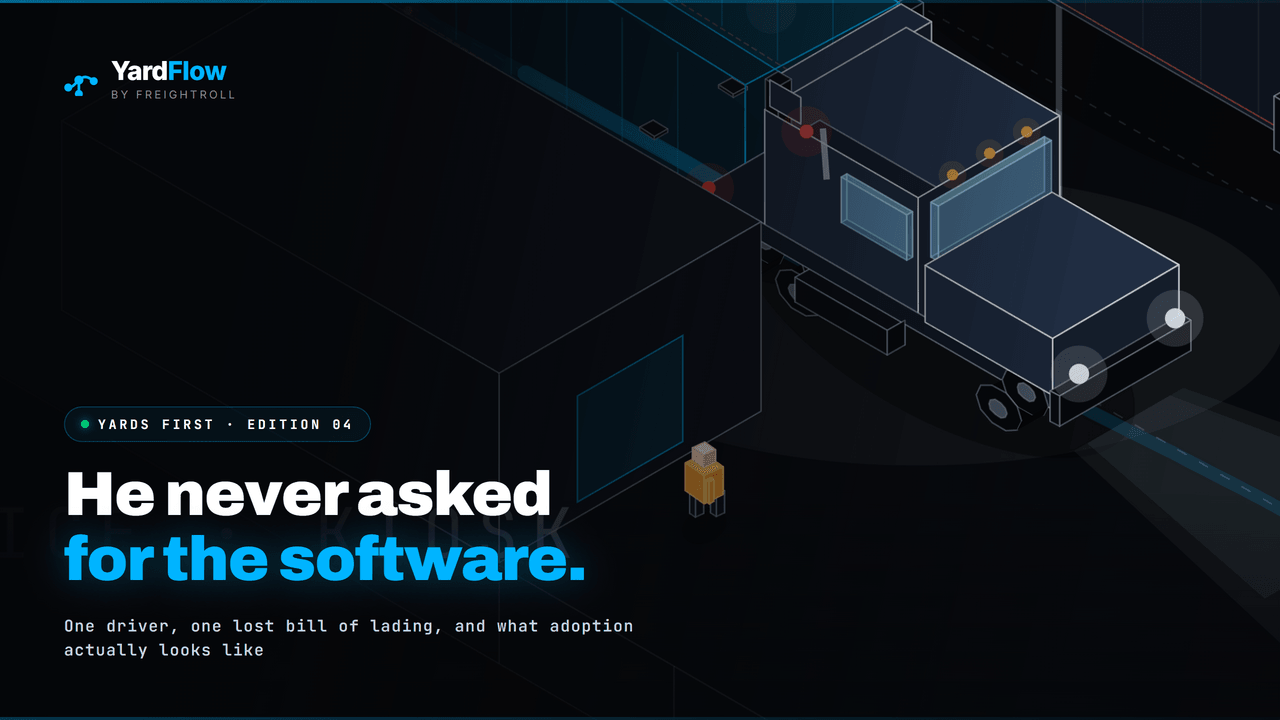
I want to tell you about a driver who took the freight version of that picture without meaning to.
What he wrote
Drivers do not want digital bills of lading. That is not a criticism, it is what we have found. Paper is what they know, paper is what the receiver has always wanted, and a driver who has been doing this for twenty years has no particular reason to believe that the phone in his cab is going to be there when it counts.
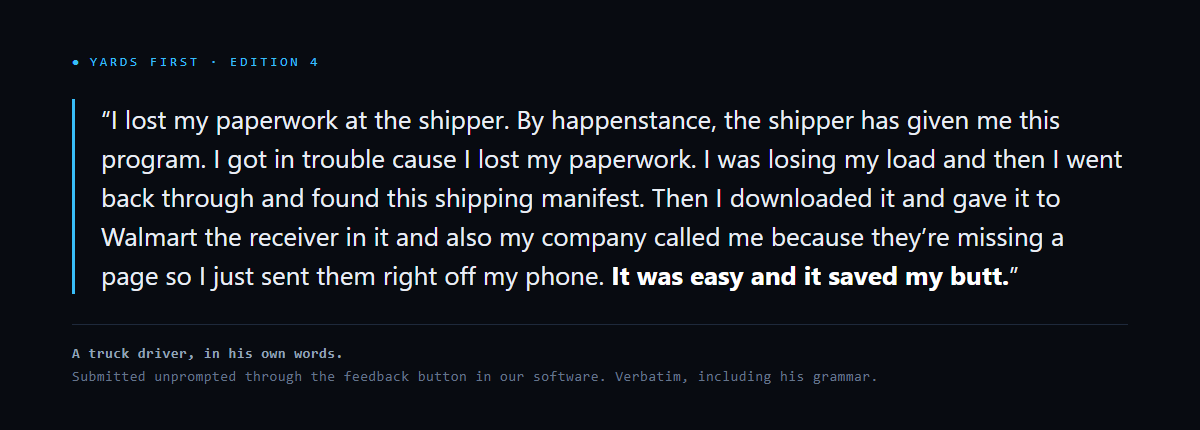
Then one of them sent this through the feedback button in our software. Nobody asked him for it. He was not given a survey about how he felt about digital paperwork. He typed it himself, unprompted, and I am not going to clean up his grammar:
"I lost my paperwork at the shipper. By happenstance, the shipper has given me this program. I got in trouble cause I lost my paperwork. I was losing my load and then I went back through and found this shipping manifest. Then I downloaded it and gave it to Walmart the receiver in it and also my company called me because they're missing a page so I just sent them right off my phone. It was easy and it saved my butt."
The nine words that matter
"By happenstance, the shipper has given me this program."
He did not choose it. He did not evaluate it. He was not persuaded by anything, and if you had asked him the week before whether he wanted his paperwork on his phone, I suspect the answer would have been short.
The shipper made a decision about how their yards run, and this driver inherited it. Then one bad afternoon he went looking for a document he had lost, found it somewhere he did not put it, and sent it to two different people from the cab of his truck.
Notice who accepted it. Paper is supposedly what the receiver insists on, and the receiver took a document off a driver's phone and the load went through.
That is the entire adoption story, and it is not the one anybody writes in a business case. You do not convince a driver. You are there, or you are not there, on the day the paper is gone.
What was actually at stake
Read the sequence again from his side. He lost the paperwork at the shipper. He got in trouble. He was losing the load. His own company called him because they were missing a page.
Now hold that next to what the same afternoon cost everybody else. The shipper lost some minutes. The receiver lost some minutes. He was the only person in that chain who was going to eat it personally, in money or in his record or in a conversation with dispatch that he would be having whether or not any of it was his fault.
That asymmetry is worth sitting with, because it never appears in the evaluation. When a network prices a digital driver journey, it prices its own minutes. The person carrying the actual risk of the paper going missing is not in the room, is not on the invoice, and does not get a vote.
He is, however, deciding whether to come back. Long haul truckload turnover runs near 90% a year by ATA's estimate, and the industry has learned to treat that as weather. I am not going to tell you how much of it is afternoons like his, because I do not know and neither does anyone else. Nobody is counting them. I will say that a driver who has one at your site knows exactly where he was standing.
What I take from it
Three things, and none of them are about our software.
The first is that a bill of lading is not paperwork. NMFTA will tell you what it actually is: a contract, a receipt, and a document of title. When a driver loses it, he has not misplaced a form. He has misplaced the only proof that he did his job.
The second is that you will almost never hear about these. This one reached us because we happened to have a feedback button and he happened to use it. The ordinary version of this story ends with a driver absorbing the cost quietly and telling nobody, least of all the shipper whose yards produced the problem. If your yards still run on paper, I would expect you are producing afternoons like his, and I would expect nothing in your reporting to show you. I cannot prove that from one survey response. That is rather the point.
The third is the uncomfortable one. Everything good that happened to him that day was an accident from his point of view. He got a backup he never asked for, from a shipper who installed it for entirely different reasons, and it happened to be there. That is a strange way to run a safety net. It works exactly as well as your last deployment decision and not one bit better.
Worth checking this week
Ask your yards one question: if a driver walked back into your dock office this afternoon and said he had lost his paperwork, what happens next?
If the answer involves somebody printing a second copy, you already know where you are. If the answer is that he can pull it up himself, from his own phone, without asking anyone, then you have quietly given several thousand people a photograph of the parking space.
The full case for sequencing the driver journey first is here: yardflow.ai/order-of-operations
Every edition: one beat from the research, one measured number, and what it means for the people who own yards.
Jake Koppinger Co-Founder and CEO, YardFlow by FreightRoll
P.S. One response is one response, and I am not going to pretend otherwise. If you run yards and you have a version of this story, the one where the paper went missing and it was somebody's bad week, I would genuinely like to hear it.
Reply on LinkedIn, where the comments are (opens in a new tab)