Guide
Trailer tracking: the last hundred yards
GPS tells you the trailer is at the DC. It cannot tell you which of 400 slots it is in, whether it is loaded, or why your driver has been circling for forty minutes.
measured
48 → 24 min
drop-and-hook turn time
live
24 sites
live on one protocol
modeled
$1M+/site
incremental profit
YardFlow Research · Updated August 2026 · Sources linked inline
Credit where due
What trailer tracking does well
Trailer trackers earn their keep on the highway. A solar or battery gateway on the trailer, a cellular ping every few minutes, and you know where every asset is between cities: location, door activity, sometimes temperature and cargo status. Vendors like Samsara, Motive, SkyBitz, Phillips Connect, and CalAmp sell this as a device plus a per-trailer subscription, and for theft recovery, utilization, and road visibility it works. Keep it.
Then the trailer turns in the gate.
The blind spot
The map goes gray at the fence line
Three things happen inside the yards. GPS that reads about five meters in the open can drift ten to twenty meters among rows of steel trailers, and against a parking slot a few meters wide that puts the dot several slots away from the truth. Battery devices stretch their ping intervals to survive, so a trailer the spotter moved twice since the last report is officially somewhere it is not. And a dot was never state to begin with: it cannot say loaded or empty, live or drop, sealed or open, or who touched it last.
So the yard check survives. Someone walks the rows to re-inventory trailers that already carry trackers and subscriptions, drivers hunt for their assignment, and per ATRI, detention runs on 39.3 percent of stops industry-wide. Trailer pools commonly run three to five trailers per tractor, which means most of a fleet is parked in yards at any given hour. Most of the fleet is inside the blind spot. Even the tracking category's own marketing sells against the "yard hunt".
Live yard state, produced by the work itself
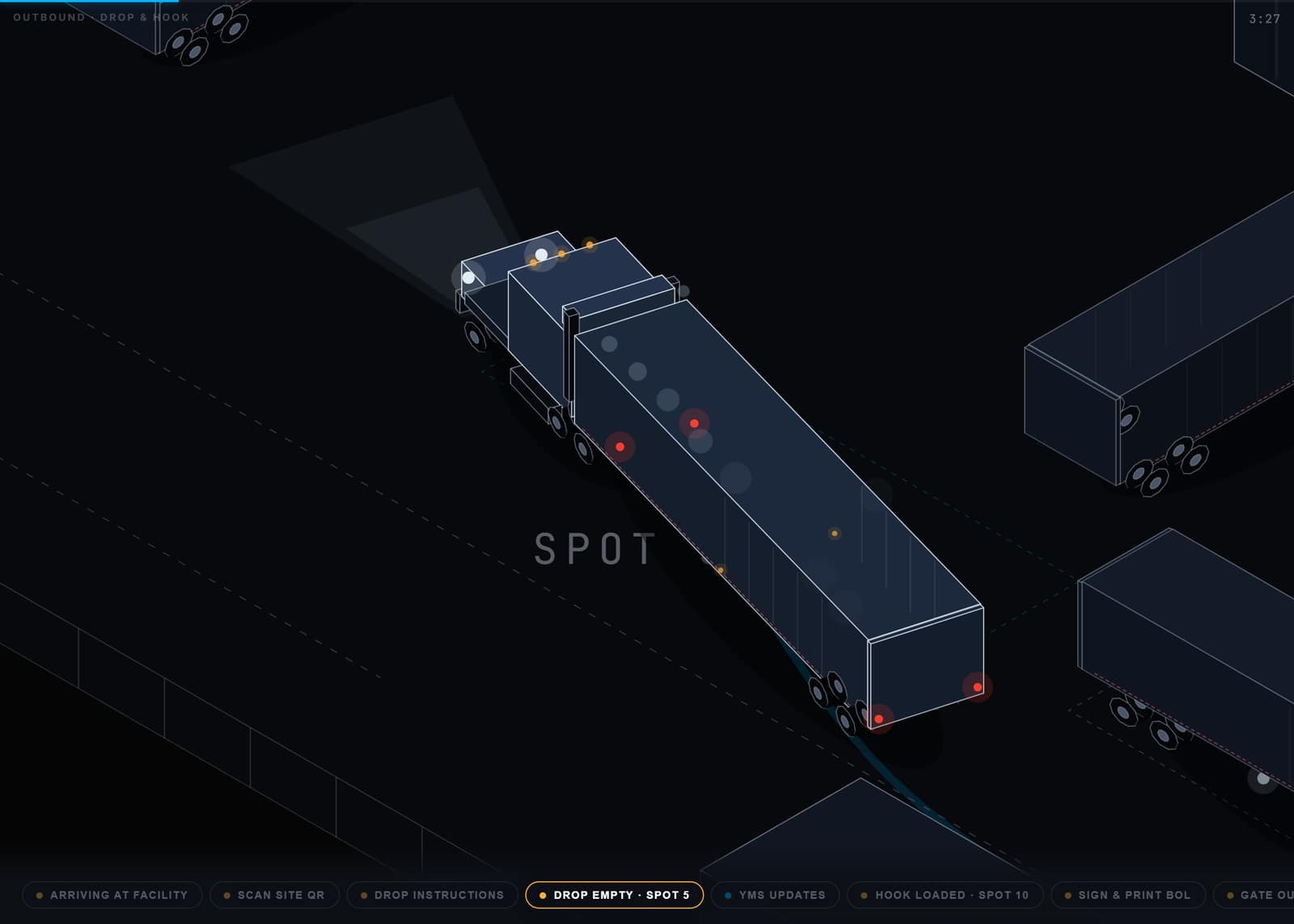
YardFlow does not bolt another powered device to every trailer. It instruments the workflow instead. The driver checks in from the cab before arrival. The gate records the trailer in, timestamped. Every spotter move writes the new slot the moment it happens. Every handoff transfers digital custody, so each trailer has one owner at every step from gate-in to gate-out.
The result is yard state as a byproduct: spot, status, custody, and history for every trailer, updated the moment a spotter drops it, not whenever the battery decides to report, at every yard in the network, including carrier and pool trailers you will never tag. Not because a sensor guessed, but because the work cannot complete without recording it. Heavier instrumentation comes last, where the numbers already prove it out.
Your trackers stay the source of truth on the road. Yard state takes over at the fence line. At Primo Brands, that workflow layer cut average gate to gate from 48 minutes to 24 across 24 live sites, measured, with about 5 percent more production capacity on flat headcount, before any hardware was added.
Q&A
Frequently asked
Does YardFlow replace our trailer GPS or telematics?
No. Trackers from vendors like Samsara, Motive, or SkyBitz are the right tool between facilities, and YardFlow works alongside them. They answer where the trailer is on the road. YardFlow answers what state it is in, in which slot, under whose custody, inside the yards. Same trailer, two different questions.
Do we need to put hardware on every trailer?
No. Yard state comes from the workflow: driver check-in, gate events, spotter moves, custody handoffs. That is why it covers every trailer that enters the yards, including carrier and pool trailers you will never own or tag. Dedicated hardware comes last, only where the economics are already obvious.
How is the yard state accurate if nothing is pinging?
Because every change of state is an event someone performs: a check-in, a gate photo, a spotter move, a handoff. The record updates the moment the work happens, so it is current to the last event, not the last ping. When the record and the yards disagree, the exception surfaces immediately instead of at the next yard check.
More guides
Pick a time and you are on the calendar.
Thirty minutes, direct with Casey Larkin. Pick an open time below and you are booked.
None of these times work? Email me at casey@yardflow.ai or call or text me at 410-236-7434, and we’ll find one.
Casey Larkin, YardFlow. Jake Koppinger, our founder, joins when it helps.