Guide
Detention charges in trucking, and the fix
Most advice tells you how to dispute the invoice. The clock that produced it started at your gate, and the clock is the fixable part.
measured
48 → 24 min
drop-and-hook turn time
live
24 sites
live on one protocol
modeled
$1M+/site
incremental profit
YardFlow Research · Updated August 2026 · Sources cited below
The charge
What detention charges are
When a driver arrives for a scheduled pickup or delivery, the facility gets a free window to load or unload, two hours by industry convention. After that, the detention clock starts. Typical rates run 50 to 100 dollars per hour for a dry van and around 125 dollars for specialized equipment like reefers and tankers. Some carriers bill more.
Detention is not a penalty for bad luck. It is the market pricing your yards. A carrier waiting at your dock is a truck not earning, and per ATRI, 94.5 percent of fleets now charge for it. Facilities that detain drivers get remembered, rated, and repriced on the next contract.
Three clocks
Detention vs demurrage vs layover
Fig. 01 · Which clock is running
| Detention | Demurrage | Layover | |
|---|---|---|---|
| Where the clock runs | Your dock or yards. | Port terminal, rail yard, or depot. | Between loads, anywhere. |
| What triggers it | Driver held past free time, usually two hours. | Container sits past its free days, usually two to seven. | Driver waiting on the next assignment. |
| How it bills | Per hour, commonly 50 to 100 dollars and up. | Per day, commonly 75 to 300 dollars per container. | Per day, set by the carrier. |
| Who fixes it | Facility operations. This is a yard-time problem. | Drayage and terminal planning. | Carrier dispatch. |
If the charge is per hour and the delay happened at your facility, it is detention, and it is yours to fix.
The bill
What detention actually costs
The American Transportation Research Institute measured it. In 2023, drivers were detained on 39.3 percent of stops, and detention cost the trucking industry 15.1 billion dollars: 11.5 billion in lost productivity and 3.6 billion in direct expenses. Fleets charged detention on 94.5 percent of eligible delays and collected on fewer than half of those invoices. The gap gets priced back into freight rates.
The federal government measured it too. A 2018 DOT Inspector General analysis found that a 15 minute increase in average dwell time raises the expected crash rate by 6.2 percent, and that detention costs truckload drivers 1.1 to 1.3 billion dollars a year in lost earnings. By that finding, every one minute reduction in average detention nationwide could prevent roughly 400 crashes a year. FMCSA is now collecting fresh detention data from roughly 80 carriers and 2,500 drivers to put current numbers behind the problem.
Your number
The industry number is 15.1 billion dollars. Yours is not in this article. The ROI model takes your facility count and shipment shape and returns your detention and dwell exposure, with every assumption labeled measured or modeled.
Run it on your network →Detention is a yard-time problem, not a billing dispute
A detention invoice is a lagging indicator. By the time it arrives, the delay already happened: the driver idled at a gate with a clipboard, waited on a dock assignment, hunted for a trailer, then queued again to leave. Disputing the invoice argues about what the clock said. It does not touch why the clock ran.
The clock runs on gate to gate time. Every minute between a truck entering your yards and leaving them is a minute against the free window. Cut gate to gate time and detention exposure falls at every site at once, without a single email to a carrier's billing department.
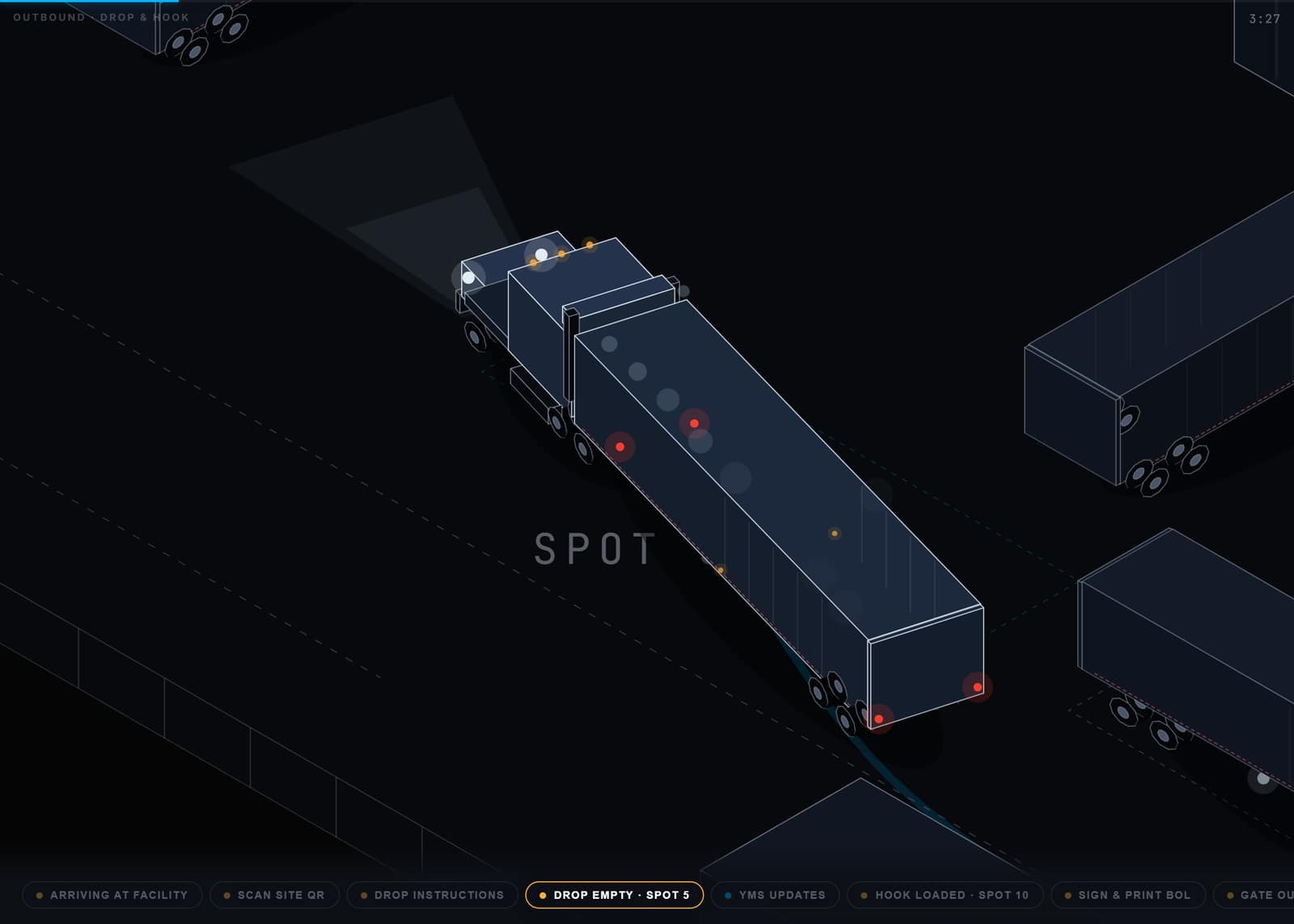
Average gate to gate at Primo Brands, measured across 24 live sites running the driver-journey workflow.
The fix is measured, not modeled. Halving the visit shrinks the tail of long stays, the ones that blow through the two hour line and become invoices. And the same timestamped gate events that run the workflow also end detention disputes, because both sides finally see the same clock.
Q&A
Frequently asked
What are detention charges in trucking?
Detention charges are hourly fees a carrier bills a shipper or receiver when a driver is held at a facility beyond the agreed free time, usually two hours. Typical rates run 50 to 100 dollars per hour for a dry van and higher for specialized equipment like reefers and tankers.
What is the difference between detention and demurrage?
Detention is a trucking charge: a driver held too long at a dock, billed per hour. Demurrage is a container charge: a loaded container sitting at a port, rail yard, or depot past its free days, billed per day. Detention points at your yards. Demurrage points at the terminal.
How do you reduce detention charges?
Reduce the time trucks spend inside your yards. Detention is billed on gate to gate time, so digital check-in, automatic dock and trailer assignment, and live yard state cut the clock itself instead of disputing it afterward. YardFlow measured this at Primo Brands: average gate to gate fell from 48 minutes to 24 across 24 sites.
Sources
More guides
Pick a time and you are on the calendar.
Thirty minutes, direct with Casey Larkin. Pick an open time below and you are booked.
None of these times work? Email me at casey@yardflow.ai or call or text me at 410-236-7434, and we’ll find one.
Casey Larkin, YardFlow. Jake Koppinger, our founder, joins when it helps.