Guide
What is yard orchestration?
Visibility tells you where the trailers are. Orchestration decides what happens next, and proves it happened.
The definition
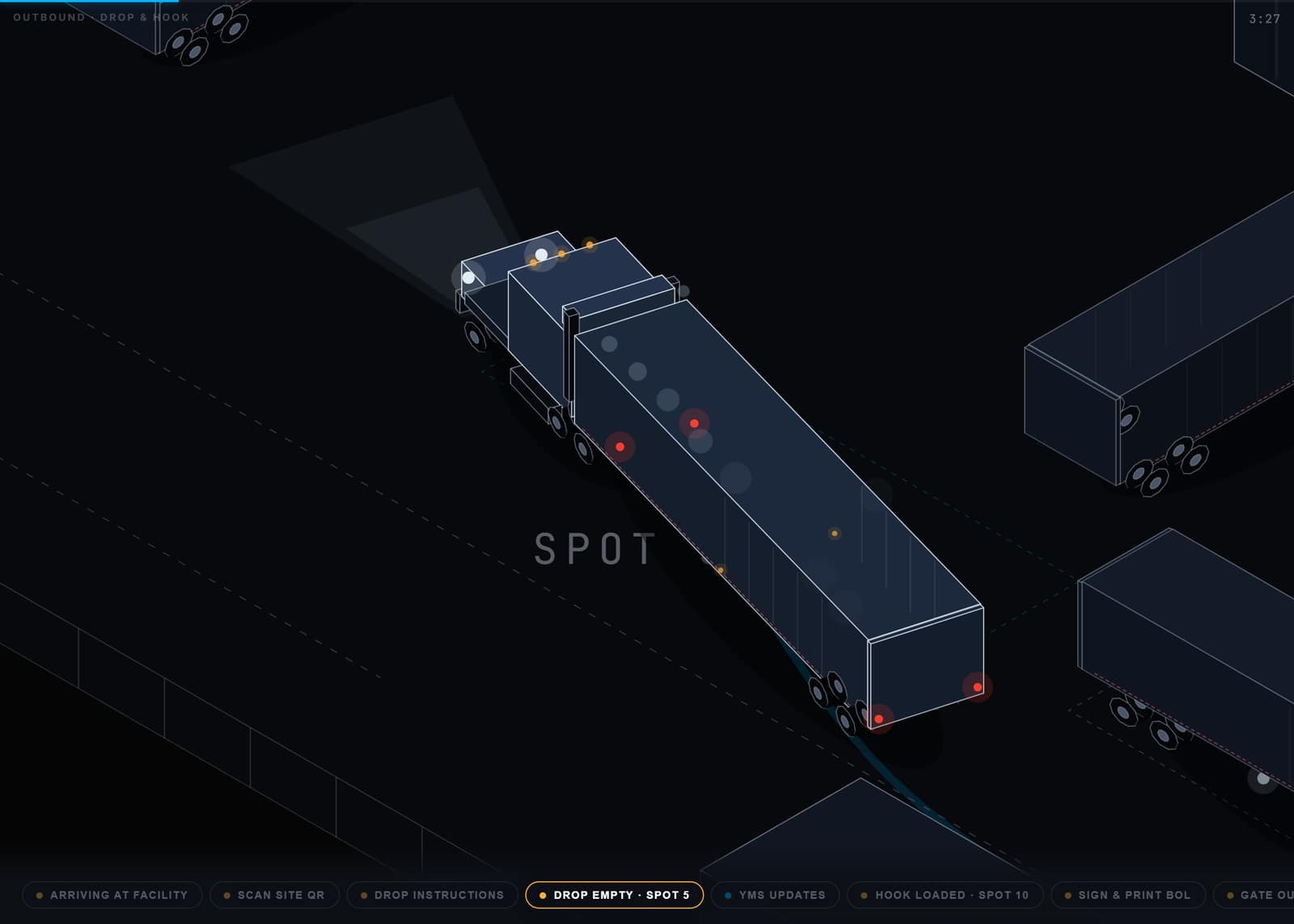
Yard orchestration is the real-time coordination of gates, docks, spotters, and drivers: which truck enters, which door it gets, which trailer moves next, and which timestamped records prove each step. It sits above yard visibility and below the planning systems. A TMS plans the freight, a WMS runs the building, and the orchestration layer runs the asphalt between them, which is where loads sit still and production lines wait.
The reason the term exists: most yards still run on a clipboard at the guard shack, radio calls to spotters, and a yard check that is stale an hour after it is walked. Orchestration replaces those with live state and dispatched moves. YardFlow eliminates the clipboard entirely: the bill of lading is captured digitally in the driver flow, with a chain of custody.
What orchestration requires
LIVE STATE
Live trailer status, dock states, and the gate queue on one screen, fed by the workflow itself, not a yard check that went stale an hour after it was walked.
DETERMINISTIC IDENTITY
The driver self-identifies by QR at arrival, tied to the load and the visit. Orchestration cannot dispatch what it cannot identify.
DISPATCH TO THE DOER
The next move reaches the spotter, the dock coordinator, and the driver in their own flow. A decision that stays on a dashboard is not orchestration.
One site vs the network
Orchestrating a single facility is a local win. The compounding case is the network: one standard driver journey, one record format, one dispatch logic at every site, so cross-site data is comparable and the rollout playbook repeats. That standard is what YardFlow calls a Yard Network System. The measured record: average gate to gate cut from 48 to 24 minutes across 24 Primo Brands sites, about 5 percent more production capacity on flat headcount, $1M+ per site modeled, and 260 sites contractually committed. The order matters too: audit and standardize the yards before automating them, which is the argument of the research paper.
Frequently asked
What is yard orchestration?
Yard orchestration is the real-time coordination of everything that moves between the gate and the dock: which truck enters, which door it gets, which trailer the spotter moves next, and which records prove each step happened. It is the layer above tracking; visibility tells you where things are, orchestration decides what happens next.
What does yard orchestration software require to work?
Three inputs: a live picture of the yards (trailer locations, dock states, gate queue), a deterministic identity for each driver and load at arrival, and a way to dispatch the next move to the person doing it. If any of the three is paper, radio calls, or a stale spreadsheet, the orchestration layer is deciding on bad data.
How is yard orchestration different at network scale?
Orchestrating one site optimizes that site. Across a network, the leverage is the standard: when every facility runs the same driver journey, the same records, and the same dispatch logic, the data is comparable, the playbook repeats, and the improvements compound. That network standard is what YardFlow calls a Yard Network System, and it is measured: average gate to gate cut from 48 to 24 minutes across 24 Primo Brands sites, with about 5 percent more production capacity on flat headcount.
More guides
Pick a time and you are on the calendar.
Thirty minutes, direct with Casey Larkin. Pick an open time below and you are booked.
None of these times work? Email me at casey@yardflow.ai or call or text me at 410-236-7434, and we’ll find one.
Casey Larkin, YardFlow. Jake Koppinger, our founder, joins when it helps.