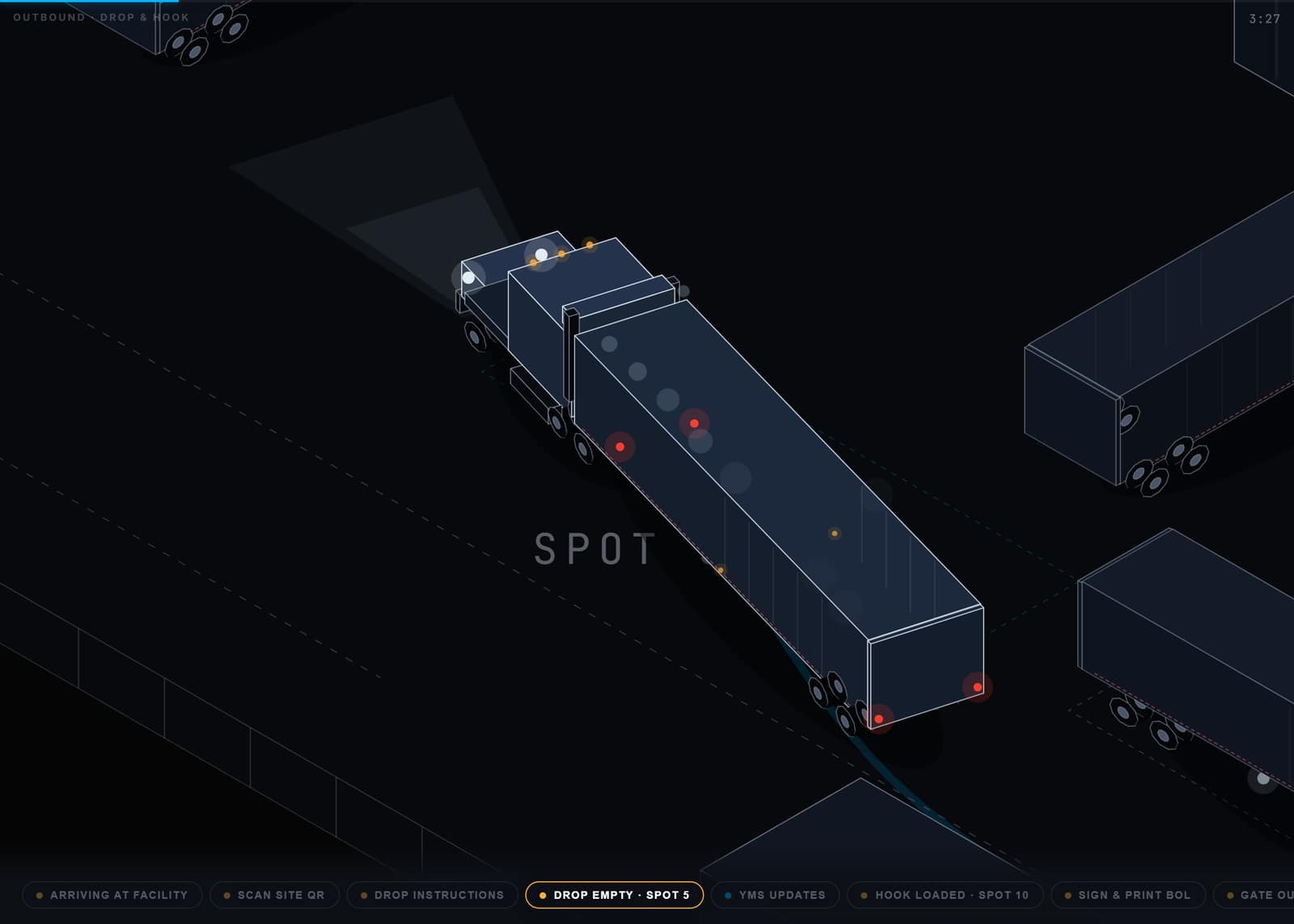
Comparison
YardFlow vs ISEE
ISEE is an MIT spinout betting that the driverless yard truck is the unit of yard modernization, with TICO manufacturing at scale from 2027. YardFlow is the protocol layer that decides what those trucks should do.
YardFlow Research · Updated August 2026 · Competitor claims from their public materials, cited below
Their build
What ISEE builds
ISEE, spun out of MIT in 2017 and headquartered in Cambridge, Massachusetts, builds AI-driven autonomous yard trucks. It deployed what it calls the world's first fully autonomous commercial truck yard for a Fortune 100 customer in Texas in 2024, runs more than 20 autonomous vehicles at customer sites, and in 2025 announced a manufacturing partnership with terminal tractor OEM TICO targeting serial production in 2027, plus a retrofit program for TICO's existing fleet. Backers include Founders Fund and Maersk Growth; cited customers include Maersk and Lazer Logistics.
ISEE has done something genuinely hard: driverless trucks executing production moves across full shifts at a live Fortune 100 facility, with a safety case validated against ISO standards. The order-of-operations paper agrees with their core premise, that private yards are where physical autonomy lands first. ISEE's own case for yards is that the environment is tightly controlled. That is the point of agreement and the point of comparison: control is not free. Something has to make the workflow deterministic enough for a robot to execute it, at one site and then at every site.
Side by side
The direct comparison
Fig. 01 · ISEE and YardFlow, dimension by dimension
| Dimension | ISEE | YardFlow (YNS) |
|---|---|---|
| Where modernization starts | Automation first: replace the human driver in the yard truck, with the surrounding operation integrated as it exists today. | Workflow first: the driver journey and custody become machine-readable structured events, then orchestration, then network standardization, then automation where the volume justifies it. |
| The bet on why yards work | Yards suit autonomy because they are private and tightly controlled: low speeds, no public road users, the vehicle can always stop safely. | Agreed, and YardFlow is what makes a yard controlled in the process sense: one standard protocol for arrival, instruction, move, and exit, so an autonomous truck inherits a deterministic workflow instead of tribal knowledge. |
| Scope of the record | The advertised core is the autonomous move; a digital bill of lading, an over-the-road driver journey, and a cross-site data standard sit outside it. | The full chain: the driver self-identifies from the cab, instructions, signature, and seal are captured as timestamped events, and the BOL carries a chain of custody across the yards. |
| Timeline and availability | Commercial deployments today on a small fleet (20-plus vehicles), with TICO serial production targeted for 2027 and orders for hundreds of trucks being secured. | Live now at network scale: 24 Primo Brands sites on one standard, 260 contractually committed, deployed remotely in about 30 minutes per site. |
| Public proof | First fully autonomous commercial truck yard (Fortune 100, Texas, 2024), thousands of moves per week, FEV-validated safety case, TICO OEM partnership. | Measured at Primo Brands: average gate to gate cut from 48 to 24 minutes across 24 live sites, about 5 percent more production capacity on flat headcount, $1M+ per site modeled. |
Q&A
Frequently asked
Is YardFlow an ISEE alternative?
Usually it is the step before ISEE, not a substitute. ISEE automates the yard truck; YardFlow standardizes the workflow the truck executes inside. An operator running its yards on one machine-readable protocol knows which sites have the move volume, the layout, and the process discipline to justify autonomous trucks, and can hand an automation vendor clean structured events instead of a site survey. The paper's position: automation is the fifth step, and it pays best when the first four are done.
When do autonomous yard trucks arrive at scale?
On ISEE's own public timeline, serial production with TICO is targeted for 2027, with pilot fleets running today. That timeline is exactly why sequence matters: the yards can be standardized this quarter, remotely, in about 30 minutes per site, so the network is measurably better now and automation-ready when the hardware ships at volume.
What does YardFlow deployment look like?
Remote, about 30 minutes per site, no hardware install. The proof of concept runs 60 to 90 days and closes on measurement: at Primo Brands, gate to gate averaged 48 minutes before and 24 after, from the driver-journey layer alone, before any physical automation.
Sources
- ISEE site
- Business Wire: ISEE Series B ($40M, Founders Fund)
- Business Wire: ISEE deploys first fully autonomous truck yard
- Business Wire: ISEE and TICO partnership
- FreightWaves: private yards and autonomous trucking (ISEE/TICO 2027)
- The Order of Operations for Autonomous Yards (YardFlow Research)
- YardFlow measured record
Competitor descriptions reflect their public materials as of August 2026. If something here is out of date, tell us and we will correct it.
Related
Pick a time and you are on the calendar.
Thirty minutes, direct with Casey Larkin. Pick an open time below and you are booked.
None of these times work? Email me at casey@yardflow.ai or call or text me at 410-236-7434, and we’ll find one.
Casey Larkin, YardFlow. Jake Koppinger, our founder, joins when it helps.