Comparison
YardFlow vs Outrider
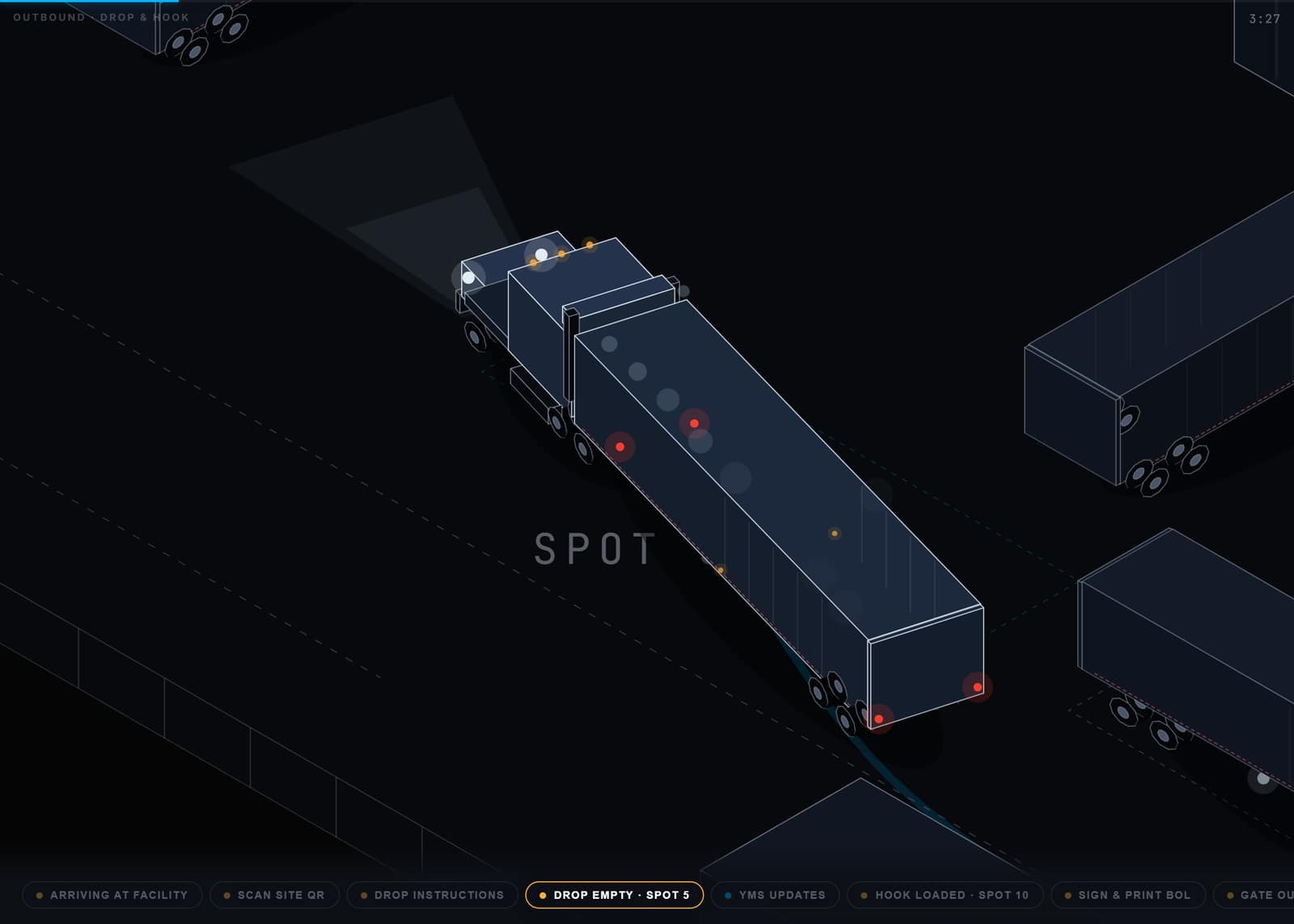
Outrider automates the trailer move: autonomous electric yard trucks, robotic hitching, yard operations as a service. YardFlow standardizes the workflow those moves run inside. This is a sequence question, not a rivalry.
YardFlow Research · Updated August 2026 · Competitor claims from their public materials, cited below
Their build
What Outrider builds
Outrider is a Colorado-based, venture-backed company (over $250M raised, backers including Koch Disruptive Technologies, NEA, and NVIDIA's NVentures) that sells autonomous yard operations as a service: an integrated system of electric autonomous yard trucks, management software, and site infrastructure. Its trucks move trailers between dock doors and parking spots, including backing, hitching, and connecting brake lines, and its publicly documented work includes 1,000-plus autonomous trailer moves in daily operations at a Georgia-Pacific distribution center and over 100,000 autonomous moves overall.
Outrider is the most heavily capitalized player in yard automation and has real production deployments behind it. For a high-volume site spending heavily on spotting services, autonomous trailer moves are a serious lever, and the order-of-operations paper is explicitly pro-automation: physical autonomy is the fifth step, the payoff move. The comparison is not whether autonomous trucks work. It is what has to be true about the yards before that investment lands, and who makes it true.
Side by side
The direct comparison
Fig. 01 · Outrider and YardFlow, dimension by dimension
| Dimension | Outrider | YardFlow (YNS) |
|---|---|---|
| Where modernization starts | Automation first: autonomous trucks, site infrastructure, and mission software automate trailer moves in the yard as it runs today. | Workflow first: the driver journey becomes machine-readable (identity, instructions, signature, seal capture, exit as structured events), then orchestration, then automation at the sites that have earned it. |
| What the software orchestrates | Its own fleet: real-time trailer inventory, move queueing, and mission management for Outrider trucks, integrated with existing WMS, YMS, and TMS. | The whole operation: driver journey, digital custody, and yard execution as one protocol, producing the clean deterministic instructions any automation, human or autonomous, executes against. |
| What the site must provide | A workflow to integrate with: Outrider's own materials describe connecting to existing management systems and installing site infrastructure per yard. | YardFlow builds that layer: a standardized, machine-readable workflow at every site, which is exactly the substrate an autonomous truck needs to be told what to move, when, and why. |
| Custody and the driver | The trailer move is the advertised core; a native digital bill of lading and an over-the-road driver self-identification journey are not part of it. | The driver checks in from the cab, no app, no guard shack, and the BOL is captured and timestamped in the flow with a chain of custody. |
| Deployment and unit of value | Per-site hardware and infrastructure delivered as yard operations as a service; value scales with trucks and infrastructure installed at each site. | Software protocol, remote deployment in about 30 minutes per site, proof of concept in 60 to 90 days; value compounds across the network because every site runs the same standard. |
| Public proof | Georgia-Pacific production deployment, 100,000-plus autonomous trailer moves, TUV SUD-reviewed safety case, over $250M raised. | Measured at Primo Brands: average gate to gate cut from 48 to 24 minutes across 24 live sites, about 5 percent more production capacity on flat headcount, $1M+ per site modeled, 260 sites contractually committed. |
Q&A
Frequently asked
Is YardFlow an Outrider alternative?
For most networks they are different steps of the same sequence, and only sometimes substitutes. Outrider automates the trailer move at a site. YardFlow standardizes the driver journey, custody, and execution protocol across the yards, which is the layer autonomous trucks consume instructions from. An operator that standardizes first knows exactly which sites have the move volume and the process discipline to justify automation, and has the clean event data to prove it.
Does YardFlow oppose autonomous yard trucks?
No. The order-of-operations research is explicitly pro-automation: physical autonomy is late-stage leverage, the fifth step after driver journey, digital custody, orchestration, and network standardization. Automating a yard that still runs on paper and radio calls automates the mess. Standardize the workflow first and automation lands on a deterministic process with measurable before-and-after economics.
What does YardFlow deployment look like next to a yard automation program?
There is no site infrastructure build: a yard goes live remotely in about 30 minutes, and a proof of concept runs 60 to 90 days. The Primo Brands record: 48 minutes gate to gate before, 24 after. That makes YardFlow the fast, low-capital first move, and it leaves the network better prepared for a hardware automation investment later, not locked out of one.
Sources
- Outrider System
- Outrider Series D press release
- Outrider: 1,000th autonomous move at Georgia-Pacific
- Supply Chain 24/7 on Outrider Series D
- The Order of Operations for Autonomous Yards (YardFlow Research)
- YardFlow measured record
Competitor descriptions reflect their public materials as of August 2026. If something here is out of date, tell us and we will correct it.
Related
Pick a time and you are on the calendar.
Thirty minutes, direct with Casey Larkin. Pick an open time below and you are booked.
None of these times work? Email me at casey@yardflow.ai or call or text me at 410-236-7434, and we’ll find one.
Casey Larkin, YardFlow. Jake Koppinger, our founder, joins when it helps.